Wildfire planning often focuses on individual buildings, but little guidance exists for effective citywide evacuation planning.


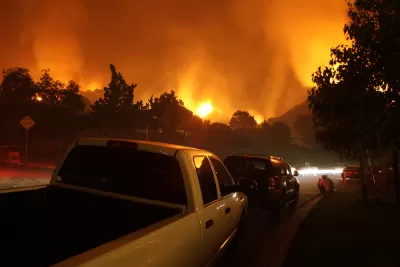
Increasingly powerful fires are devastating communities around the world, with tens of thousands of people already affected this year. “And yet, when it comes to things like planning evacuations, best practices don’t really exist—there’s no book to consult, no checklist to follow,” writes Caroline Mimbs Nyce in The Atlantic.
“The reason for this is that wildfire-evacuation research is still in its infancy,” Mimbs Nice explains. Although robust fire codes for buildings do exist, the same can’t be said for whole communities. Meanwhile, the unpredictable nature of fire makes it difficult to model predicted outcomes and establish protocols.
Mimbs Nyce outlines the challenges faced by authorities and residents during a fire: notification, time to meet with loved ones and get essentials, and transit time out of an affected area, which can be affected by road design, exit routes, and traffic. In addition to evacuation preparations, a town can also designate a highly protected gathering place as a refuge for people unable to flee.
Ali Mosleh, director of the B. John Garrick Institute for the Risk Sciences at UCLA, emphasizes the importance of developing standards catered to the needs of different types of communities. “They might need different numbers of evacuation routes, and different sorts of community-warning systems. Existing tools and simulations, like the one run on Camp Fire data, can help guide policy makers.”
Read the full story: The World Needs to Start Planning for the Fire Age


More Colorado Suburbs at Risk for Wildfires
Experts warn that more intense fires fueled by a warming climate are threatening an increasing number of Colorado's suburban communities.

Rebuilding Smarter: How LA County Is Guiding Fire-Ravaged Communities Toward Resilience
Los Angeles County is leading a coordinated effort to help fire-impacted communities rebuild with resilience by providing recovery resources, promoting fire-wise design, and aligning reconstruction with broader sustainability and climate goals.
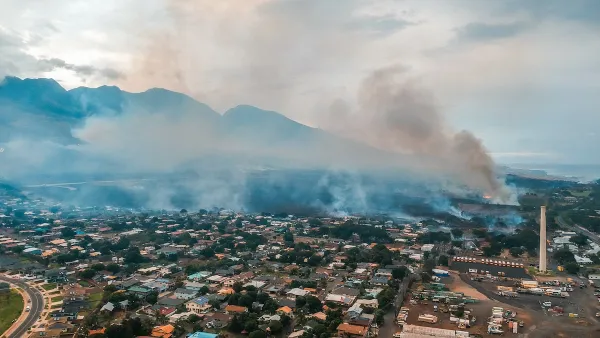
Maui's Deadly Firestorm: Investigating the Tragedy and Lessons for the Future
FRONTLINE's Maui’s Deadly Firestorm investigates the 2023 Lahaina wildfire, uncovering critical failures in preparedness and response while examining the tragedy’s causes, impact, and lessons for future disaster prevention.

Planetizen Federal Action Tracker
A weekly monitor of how Trump’s orders and actions are impacting planners and planning in America.

HUD modernizes 50-year-old manufactured housing framework
The Next Generation Manufactured Housing Action Plan establishes new energy-efficiency standards for manufactured homes, and new guidelines for anchoring them.

Data reveals that NYC’s bet on congestion pricing has paid off
After almost two years of the program, reports show positive impacts on traffic and air quality and no disruptions to parking.

How Chicago, New York and Seattle are funding transit projects amid tough times
Notes from the American Public Transportation Association's TransForm conference in Chicago.

Transport for London tackles hate crime spike with free bystander training
Recorded hate crime offences on the London's transport network have increased by 36 per cent.

Denver is solving homelessness. Why aren't the rest of us?
Since 2023, Denver's street homeless population has decreased by 64%, proving that effective tools exist to support those in need of housing.

FREE Course: Walkable City 1: Why Walkability?
After describing his path towards focusing on walkability as the essence of good planning, Jeff Speck marches through his five principal reasons for making more walkable places.
Reinventing Malls: Planning Alchemy—Turning Gray Fields Into Gold
The course focuses on the opportunities and imperatives that shape reinvention of mall sites.

One Hundred Miles
County of Mendocino
planning NEXT
The Architects Foundation
University of Cincinnati Online
Montrose County
Northern Illinois Transit Authority (NITA)
The Pocatello Development Authority