A growing number of cities in California have prohibited the construction of new gas stations. Los Angeles could soon consider an ordinance to do the same—in a landmark move for the city some believe to be a symbol of car-dependent sprawl.


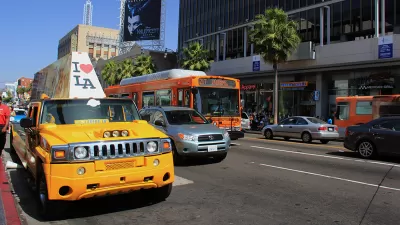
The city of Petaluma in the North Bay Area in California in 2021 was the first city in the country, and maybe the world, to prohibit the construction of new gas stations as a climate action.
It turns out, that Petaluma was first, but it hasn’t been the last.
“Since Petaluma’s decision, four other cities in the Bay Area have followed suit, and now, leaders in California’s most car-centric metropolis are hoping to bring the climate-conscious policy to Southern California,” reports Grace Toohey for the Los Angeles Times.
Los Angeles, the state’s largest city by population, and a symbol of sprawl in public perception, is among those cities to have consider a similar change, although a proposal by Councilmember Paul Koretz to begin drafting a ordinance to ban new gas stations hasn’t yet produced results.
“While Petaluma officials at the time called its new gas pump ban ‘completely uncontroversial,’ it’s unclear how such a policy would go over in Los Angeles, a city with about 65 times as many people and a transportation infrastructure that still heavily relies on vehicles,” writes Toohey. “Lobbyists for gas stations said they will oppose the motion in L.A. if it moves forward.” A 2020 executive order by Gov. Gavin Newsom to sunset the sale of gas vehicles in the state by 2035 provides some context, and incentive, for Los Angeles to figure it out.
FULL STORY: California cities ban new gas stations in battle to combat climate change


California City the First to Ban New Gas Stations
With the state mandating a switch to electric vehicles by 2035, Petaluma is aligning its land use regulations with its climate goals.

On the Essential Role of Land Use in the Fight Against Climate Change
The country cannot hope to achieve its goals for the reduction of greenhouse gas emissions without fundamentally rethinking its land use and development patterns, according to this article.

LA County Adopts First Heat Action Plan
LA County has adopted its first Heat Action Plan, a long-term, people-centered framework to reduce heat risks, protect public health, and adapt communities, homes, and public spaces to a hotter and more dangerous climate.

Planetizen Federal Action Tracker
A weekly monitor of how Trump’s orders and actions are impacting planners and planning in America.

The state-sanctioned urbicide of Austin
People don’t kill cities. Freeways do.

US to reduce Colorado River water deliveries to Mexico
A new Colorado Treaty amendment reduces Mexico’s Colorado River water allocation by 250,000 acre feet.

Mamdani overhauls NYC's Vision Zero plan with 100 new policy goals
The overhaul aims to reduce traffic deaths and make streets safer for pedestrians, cyclists and drivers through lower speed limits, new safety infrastructure and more.

Amtrak not solely to blame for New Jersey commuter rail's unreliability, report finds
A new study from the Garden State Initiative found that NJ Transit’s budget grew 20% across a 4 year period, but reliability declined significantly over the same period.

EPA erases limits on planet-warming pollution from power plants
Under Monday’s plan, power plants would still have some limits on how much mercury, arsenic and other contaminants they can emit.

FREE Course: Walkable City 1: Why Walkability?
After describing his path towards focusing on walkability as the essence of good planning, Jeff Speck marches through his five principal reasons for making more walkable places.
Reinventing Malls: Planning Alchemy—Turning Gray Fields Into Gold
The course focuses on the opportunities and imperatives that shape reinvention of mall sites.

Eagle County Government
Harvard University Graduate School of Design
Nashville Planning Department
The Architects Foundation
University of Cincinnati Online
The Pocatello Development Authority
The Urban Renewal Agency of the City of Pocatello
Journal of the American Planning Association