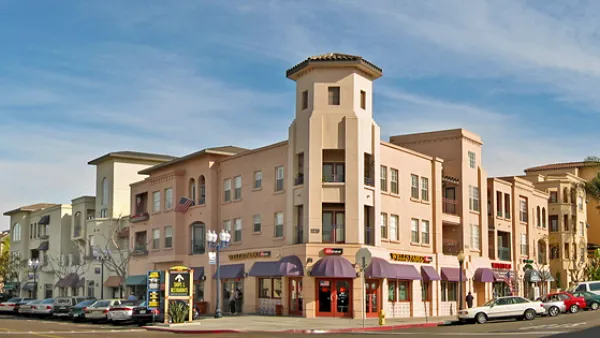
Going above and beyond California’s state-level housing density bonus law, San Diego launched its own program to encourage developers to build more affordable units.



“The cost of buying or renting a home has surged in many urban regions across the U.S. over the past few years, resulting in more people falling behind on rent, being evicted and experiencing homelessness. The rising costs, housing experts say, are largely due to a lack of housing to accommodate population growth.”
To address this growing problem, writes Danielle McLean, “California [enacted] a density bonus law allowing developers to build more units if they designate a certain proportion as affordable. San Diego took that idea a step further in establishing its own enhancement to that law in 2016, allowing developers to build even more units when they include a higher number of affordable ones.”
A new report from Circulate San Diego reveals that the program was used in projects that created over 6,000 housing units. “And from 2016 to 2020, it was used to create 463 deed-restricted affordable homes in mixed-income projects, financed primarily without relying on public subsidy.” Of these, 95 percent were located within a half mile of a “high-performing” transit stop.
“The city has also been regularly updating its building codes, taking into account feedback about where in the permitting process projects get hung up and how to streamline those processes, said [Heidi Vonblum, San Diego's planning director].”
Read the full story: San Diego housing density bonus is spurring affordable units: report

California Court Upholds Density Bonus Law
In a rebuff to proponents of local control, a California state appeals court upheld a 1979 law that allows developers to bypass local zoning regulations when including affordable housing in their projects.
Middle-Income Density Bonus Working Toward Approval in San Diego
The San Diego City Council's Land Use and Housing Commission approved a density bonus program to provide incentives for developers to build middle- and low-income housing.

San Diego establishes $8.5M affordable housing fund
The new fund will let local nonprofits and developers apply for funding to shore up the city's affordable housing stock.

Planetizen Federal Action Tracker
A weekly monitor of how Trump’s orders and actions are impacting planners and planning in America.

California plans to bury El Niño’s downpour
If the state plays its cards right, it may be able to store a billion acre-feet of El Niño’s water in aquifers.

Desperate measures: Advocates weigh draining Lake Powell to fill Colorado River
Draining the reservoir could reduce evaporation losses by a couple hundred thousand acre-feet.

Mamdani’s pied-à-terre tax survives legal challenge
A panel of judges found that the plaintiffs failed to demonstrate injury as a result of New York City's implementation of the tax.

Eastern Nebraska is running out of electricity
Data centers and electrification are straining eastern Nebraska’s grid, throttling economic development.

Seattle passes record-breaking transit services expansion
Proposition 1 will double the city’s transit tax to add 95,000 more bus trips and preserve 180,000 bus trips annually.

FREE Course: Walkable City 1: Why Walkability?
After describing his path towards focusing on walkability as the essence of good planning, Jeff Speck marches through his five principal reasons for making more walkable places.
Reinventing Malls: Planning Alchemy—Turning Gray Fields Into Gold
The course focuses on the opportunities and imperatives that shape reinvention of mall sites.

City of Rosemead
Rutgers University, Edward J. Bloustein School of Planning and Public Policy
One Hundred Miles
University of Michigan School for Environment and Sustainability (SEAS)
Hunter College, City University of New York (CUNY)
The Architects Foundation
City of Cambridge
Montrose County
The Pocatello Development Authority