A recent survey shows overwhelming support for denser housing options, with younger people and renters most likely to support ‘missing middle housing’ types.


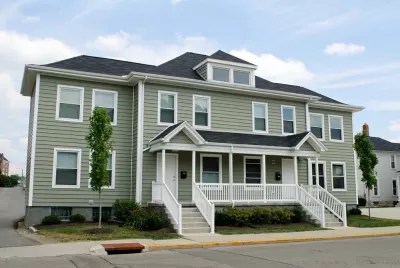
“The results of a comprehensive new Zillow survey gauging the views of 12,000 adult residents in 26 major metro areas on the topic of neighborhood-densifying housing options show that a resounding majority of those polled support allowing forms of missing middle housing such as accessory dwelling units (ADUs) and duplexes/triplexes in their own figurative, and perhaps literal, backyards.”
Matt Hickman describes the survey results, noting that “Support for missing middle housing was strongest among younger age groups with 86 percent of Gen Zers (ages 18–27) and Millennials (ages 28–42) backing ADUs or duplexes/triplexes.” However, the majority of older respondents also supported lightly increased density. Meanwhile, “Support for missing middle housing in residential neighborhoods was strongest from those polled who identify as renters,” who can suffer most from volatile housing costs.
Younger people were also more likely to favor housing over parking. “Within the youngest Gen-Z age category, 72 percent of residents agreed that affordable housing is more important than free parking while in the oldest age group, boomers and the Silent Generation, slightly less than half of respondents were in agreement.”
In an all-too-common paradox, “While most respondents agreed that multi-family projects would prove beneficial by boosting the number of affordable housing options in their respective neighborhoods (68 percent), fewer overall (57 percent) indicated that they would actually support such a building being constructed.”
FULL STORY: Millennials and Gen Z strongly support “missing middle” housing, Zillow survey says


Harvard Report Cites Zoning, Construction Costs as Obstacles to New Housing
Zoning restrictions and onerous building codes make mid-sized multifamily housing prohibitively expensive or illegal to build.

Arizona Legalizes ADUs and Higher Downtown Density Statewide
Two new laws require cities to permit ‘missing middle housing’ near city centers and ADUs on all single-family lots.

Dallas Code Reform Makes Way for Missing Middle Housing
The Dallas City Council voted to change the city’s building code to allow up to eight residential units in three-story buildings.

Planetizen Federal Action Tracker
A weekly monitor of how Trump’s orders and actions are impacting planners and planning in America.

The state-sanctioned urbicide of Austin
People don’t kill cities. Freeways do.

US to reduce Colorado River water deliveries to Mexico
A new Colorado Treaty amendment reduces Mexico’s Colorado River water allocation by 250,000 acre feet.

Mamdani overhauls NYC's Vision Zero plan with 100 new policy goals
The overhaul aims to reduce traffic deaths and make streets safer for pedestrians, cyclists and drivers through lower speed limits, new safety infrastructure and more.

Amtrak not solely to blame for New Jersey commuter rail's unreliability, report finds
A new study from the Garden State Initiative found that NJ Transit’s budget grew 20% across a 4 year period, but reliability declined significantly over the same period.

EPA erases limits on planet-warming pollution from power plants
Under Monday’s plan, power plants would still have some limits on how much mercury, arsenic and other contaminants they can emit.

FREE Course: Walkable City 1: Why Walkability?
After describing his path towards focusing on walkability as the essence of good planning, Jeff Speck marches through his five principal reasons for making more walkable places.
Reinventing Malls: Planning Alchemy—Turning Gray Fields Into Gold
The course focuses on the opportunities and imperatives that shape reinvention of mall sites.

Eagle County Government
Harvard University Graduate School of Design
Nashville Planning Department
The Architects Foundation
University of Cincinnati Online
The Pocatello Development Authority
The Urban Renewal Agency of the City of Pocatello
Journal of the American Planning Association