The battle over the efficiencies and infrastructure required in building codes continues.



In March 2021, the International Code Council (ICC), a private consortium that controls building code regulations for most of the United States and Latin America, voted to "reduce the power of cities and local jurisdictions over building efficiency requirements," according to March 2021 Planetizen coverage of the news.
The ICC's vote came as a final, sweeping blow in a long battle by industry powers to push back against local control over local building and energy laws. With its March 2021 vote, the ICC decided to remove code making powers from local governments, placing those responsibilities instead in the hands of a "technocratic committee that gives companies equal say to public servants," according to Alexander C. Kaufman, writing for the Huffington Post (Kaufman also provided breaking new coverage of the ICC vote in March 2021).
Kaufman is still tracking the ongoing battle over carbon emissions from the nation's building stock. In March 2022, Kaufman reports that "new drama is afoot" at the ICC, after "a single email secretly sent by a gas utility nearly gutted a proposal widely seen as vital to increasing the adoption of electric vehicles."
Here are the salient details of the drama:
After weeks of discussion over a proposal to require developers to include the circuitry to charge electric vehicles in more new buildings ― which can cost more than six times more to retrofit into a structure after it’s built ― the chairman of the committee, Duane Jonlin, abruptly announced in an email that he had decided to strike the proposal from the code. Instead, he said it belonged in the “appendix” that serves as a bonus menu that some more ambitious cities and towns may choose to adopt, according to copies of the exchange HuffPost obtained from a source who requested anonymity because the internal emails were private.
Kaufman and the HuffPost team dig deeper via public records request, reporting that Spire Energy, the $3.5 billion St. Louis-based gas company, "privately reached out to challenge the electric vehicle provisions."
According to Kaufman, environmentalists and code reform advocates fear the incident reveals broader leverage for polluters in building codes than before last year's vote.
FULL STORY: A Battle Over Building Codes May Be The Most Important Climate Fight You’ve Never Heard Of


California Adopts CEQA Reforms for Infrastructure, Leaves Out Residential
The state of California adopted reforms to the California Environmental Quality Act (CEQA) pertaining to climate-friendly infrastructure projects, but residential development interests hoping for relief from CEQA will have to wait.

Landmark Climate Decision Rules in Favor of Montana Youth
The ruling in Held v. Montana is the first of its kind in the United States, according to reports.
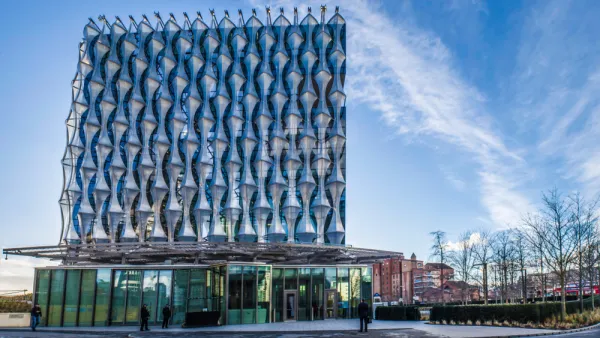
The Net Zero Building Boom Is Ready to Scale
While the cultural and infrastructural changes necessary to eliminate carbon emissions from the transportation sector still seem far-fetched, scaling up a net zero building boom is “eminently possible.”

Planetizen Federal Action Tracker
A weekly monitor of how Trump’s orders and actions are impacting planners and planning in America.

The state-sanctioned urbicide of Austin
People don’t kill cities. Freeways do.

US to reduce Colorado River water deliveries to Mexico
A new Colorado Treaty amendment reduces Mexico’s Colorado River water allocation by 250,000 acre feet.

Colorado’s Largest Data Center Could Rise Next to Homes — Without a Public Hearing
The proposed campus would consume 11 times the power of Denver International Airport; as it has across the country, opposition mounts.

5 New England states march closer to 800 megawatt wind energy project
Securing federal approval for the project may be complicated under the Trump administration, which has historically been hostile towards domestic wind power.

Baltimore to break ground on $50 million Transit Priority Project
The project will bring faster bus trips, safer streets and better bike connections to Baltimore.

FREE Course: Walkable City 1: Why Walkability?
After describing his path towards focusing on walkability as the essence of good planning, Jeff Speck marches through his five principal reasons for making more walkable places.
Reinventing Malls: Planning Alchemy—Turning Gray Fields Into Gold
The course focuses on the opportunities and imperatives that shape reinvention of mall sites.

Eagle County Government
Harvard University Graduate School of Design
Nashville Planning Department
The Architects Foundation
University of Cincinnati Online
The Pocatello Development Authority
The Urban Renewal Agency of the City of Pocatello
Journal of the American Planning Association