Although the survey collects data from a small sample, it looks like North American planners don't expect the pandemic to change much about the way cities are planned.


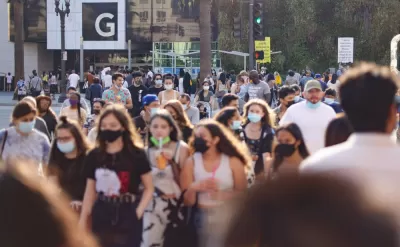
A recent survey indicates that planners don't intend to change much in their approach to urban planning, despite the various disruptions and influences of the Covid-19 pandemic.
Researchers at the University of Waterloo in Canada surveyed 98 city planners (after disseminating the survey via the Canadian Institute of Planners Newsletter, the American Planning Association's Interact newsletter, and various planning-related social media groups) about the future of planning in mid-sized urban areas as a response to the Covid-19 pandemic, publishing the results in the Planning Practice & Research journal (the study is currently available in full online) in December.
"Despite calls for greater creativity and innovation, there is essentially no difference between what planners viewed as more important to downtowns pre-and-post the pandemic," says Pierre Filion, an emeritus professor in the School of Planning at Waterloo, as quoted in an article by David Malone for Building Design + Construction that shared news of the new research.
Like the public and the media, the surveyed planners are certainly aware of the negative effects of the pandemic. Among the study respondents, 60% "indicated that the pandemic had a substantial negative effect on downtowns," according to the study. "The survey respondents perceived that the most severe effects of the pandemic were experienced by eating and drinking establishments, with substantial negative effects being reported by more than 75% of the respondents."
Yet, the survey did not reveal that planners expect to produce a commensurate response in the form of reform and innovation. From the discussion of the journal article:
The survey findings reveal a disconnect regarding planner’s perceptions of the drivers of downtown recovery after Covid. On the one hand, despite calls for greater creativity and innovation, there are essentially no differences between what planners viewed as important to downtowns pre-and-post the pandemic. This suggests that they are not ‘planning’ on fundamental changes to past practice even in the face of a changing reality, or a ‘new normal.’
The full Planning Practice & Research article can be found at the link below.
FULL STORY: Planning for Post-pandemic Downtowns of Mid-size Urban Areas

It's Time for Public Participation to Evolve With Transportation Planning
A manifesto by planning and transportation professionals committing to hearing all voices during public engagement processes.
Light at the End of the Tunnel Reveals the Work to Come
The latest edition of an ongoing compendia of articles trying to make sense of the deep uncertainties of the pandemic—and what it all means for the future of cities.
Haves and Have Nots: Planning and the Deep Divides of the Pandemic
The latest in a series of compendia gathering news and analysis about the effects of the COVID-19 on the built and natural environments—now and long into the future.

Planetizen Federal Action Tracker
A weekly monitor of how Trump’s orders and actions are impacting planners and planning in America.

The state-sanctioned urbicide of Austin
People don’t kill cities. Freeways do.

US to reduce Colorado River water deliveries to Mexico
A new Colorado Treaty amendment reduces Mexico’s Colorado River water allocation by 250,000 acre feet.

Mamdani overhauls NYC's Vision Zero plan with 100 new policy goals
The overhaul aims to reduce traffic deaths and make streets safer for pedestrians, cyclists and drivers through lower speed limits, new safety infrastructure and more.

Amtrak not solely to blame for New Jersey commuter rail's unreliability, report finds
A new study from the Garden State Initiative found that NJ Transit’s budget grew 20% across a 4 year period, but reliability declined significantly over the same period.

EPA erases limits on planet-warming pollution from power plants
Under Monday’s plan, power plants would still have some limits on how much mercury, arsenic and other contaminants they can emit.

FREE Course: Walkable City 1: Why Walkability?
After describing his path towards focusing on walkability as the essence of good planning, Jeff Speck marches through his five principal reasons for making more walkable places.
Reinventing Malls: Planning Alchemy—Turning Gray Fields Into Gold
The course focuses on the opportunities and imperatives that shape reinvention of mall sites.

Eagle County Government
Harvard University Graduate School of Design
Nashville Planning Department
The Architects Foundation
University of Cincinnati Online
The Pocatello Development Authority
The Urban Renewal Agency of the City of Pocatello
Journal of the American Planning Association