The proliferation of private EV charging services, coupled with federal investment in charging stations, has the potential to reduce 'charging anxiety' and encourage a faster switch to electric vehicles.


The rise of electric vehicle charging programs known as 'EV Charging As A Service' could help speed up EV adoption and build out the nation's network of charging stations, writes Steve Tengler in Forbes. The growth of a private charging industry alongside government-funded charging stations could ease "charging anxiety" experienced by drivers considering making the switch from gas-powered vehicles and businesses seeking to electrify their fleets. "Regardless of potential fuel savings, businesses cannot have valuable assets either experiencing downtime or non-productive mileage," Tengler says.
The concept is that such services provide lower risk solutions with greater flexibility to small- and mid-sized businesses or multifamily properties, especially where multiple vehicles need charging. The Charging As A Service program removes the burden of ownership and maintenance from the charging host by providing such things as turnkey EV charging stations, management software, 24/7 driver support, professional field maintenance, etc.
As Tengler notes, "Any rollout plan for a technology shift requires some early adoption from the market segments with the greatest need, which in turn reduces the price point or impediment to widespread adoption."
Read the full story: ‘Charging As A Service’ For Electric Vehicles Growing As A Market Offering

Walmart Announces Nationwide EV Charging Network
The company plans to install electric car chargers at most of its stores by 2030.
The Future of EV Charging Stations and Urban Planning
Explore the future of EV charging in cities and discover urban planning strategies for integrating electric vehicle infrastructure and promoting sustainable transportation.
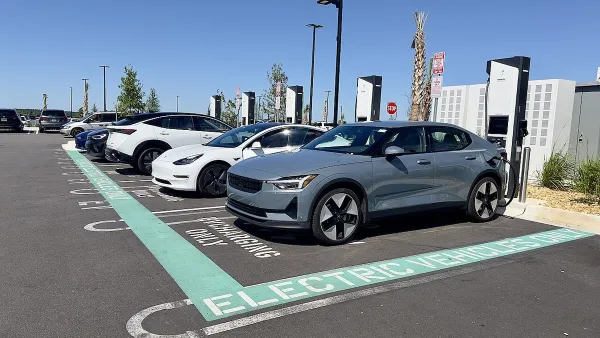
Florida Law Bars Cities From Regulating EV Chargers
Under the new law, cities cannot require charging infrastructure in local codes.

Planetizen Federal Action Tracker
A weekly monitor of how Trump’s orders and actions are impacting planners and planning in America.

California plans to bury El Niño’s downpour
If the state plays its cards right, it may be able to store a billion acre-feet of El Niño’s water in aquifers.

Desperate measures: Advocates weigh draining Lake Powell to fill Colorado River
Draining the reservoir could reduce evaporation losses by a couple hundred thousand acre-feet.

Mamdani’s pied-à-terre tax survives legal challenge
A panel of judges found that the plaintiffs failed to demonstrate injury as a result of New York City's implementation of the tax.

Eastern Nebraska is running out of electricity
Data centers and electrification are straining eastern Nebraska’s grid, throttling economic development.

Seattle passes record-breaking transit services expansion
Proposition 1 will double the city’s transit tax to add 95,000 more bus trips and preserve 180,000 bus trips annually.

FREE Course: Walkable City 1: Why Walkability?
After describing his path towards focusing on walkability as the essence of good planning, Jeff Speck marches through his five principal reasons for making more walkable places.
Reinventing Malls: Planning Alchemy—Turning Gray Fields Into Gold
The course focuses on the opportunities and imperatives that shape reinvention of mall sites.

City of Rosemead
Rutgers University, Edward J. Bloustein School of Planning and Public Policy
One Hundred Miles
University of Michigan School for Environment and Sustainability (SEAS)
Hunter College, City University of New York (CUNY)
The Architects Foundation
City of Cambridge
Montrose County
The Pocatello Development Authority