A high-profile example of the power of the California Environmental Quality Act (CEQA) might cause thousands of students to miss out on a chance to attend the University of California, Berkeley.


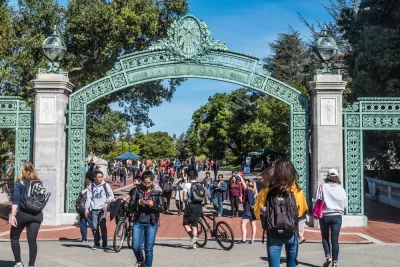
"About 5,100 fewer high school seniors and transfer students will be offered a place at Cal for the next academic year because of an Alameda County Superior Court ruling that ordered UC Berkeley to freeze enrollment at the same level as 2020-21," reports Frances Dinkelspiel for Berkeleyside.
"The 24% drop in offer letters would bring about 6,450 new students to Cal — about 32% fewer than in a typical year," adds Dinkelspiel.
Planetizen picked up the news about the earlier enrollment freeze, also reported by Dinkenspiel for Berkleyside, in August 2021. Since then, the California First Court of Appeal turned down the university's request for a stay of the decision. Now the hopes for those 32 percent of students rests on the California Supreme Court—if the state's highest judicial body can even act in time for the March 23 date set for the university to mail its admission levels.
The controversy over the court ruling and its impact on enrollment at one of the top public universities in the world, hinges completely on planning--specifically the California Environmental Quality Act (CEQA), which requires environmental reviews of projects of certain size and potential impact, and also creates an effective form of local veto.
In this case, local neighborhood group Save Berkeley’s Neighborhoods used CEQA to sue the university on the grounds that the university should have prepared an environmental impact report for a plan to increase its enrollment by 2022-23.
"UC Berkeley did not do a separate EIR on the enrollment increase but instead examined it as part of an EIR for the Upper Hearst Development project, which will add a new building for the Goldman School of Public Policy and adjacent housing for about 225 people. UC Berkeley also focused in the EIR on the impacts of the increased enrollment to the main campus rather than the city," explains Dinkenspiel.
The August enrollment cap came along with a decision by Alameda County Judge Brad Seligman to toss the EIR for the Upper Hearst project.
Phil Bokovoy, the president of Save Berkeley’s Neighborhoods, seems unmoved by the potential of thousands of students losing access to the university. Bokovoy wrote in a court document that "Cal admits so many out-of-state students that it could reduce those numbers — and hold the number of graduate students to their 2019 numbers — and still admit all the California students who apply," according to Dinkenspiel's summary of the statement.
The news about the enrollment snafu was also picked up yesterday by Teresa Watanabe for the Los Angeles Times.
The news is the latest in a string of news about development opposition in California. Earlier this month, the city of Woodside declared itself mountain lion habitat in a failed attempt to avoid recent statewide zoning laws. A ballot initiative that would overturn those same state laws is also seeking signatures to qualify for a statewide vote.
FULL STORY: UC Berkeley must slash new enrollment by a third unless high court intervenes

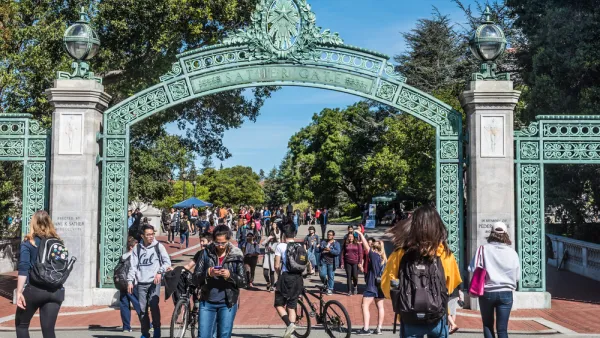
Judge Caps Enrollment at UC Berkeley Pending Environmental Impact Report
An Alameda County judge dealt a stunning rebuke of a plan to expand the campus of the University of California, Berkeley, with housing and new space for the Goodman School of Public Policy.
Opinion: How California’s Environmental Law Empowers NIMBYs
Critics of a new provision calling “social noise” an environmental impact say the law can too easily be co-opted by anti-housing groups to block new development.
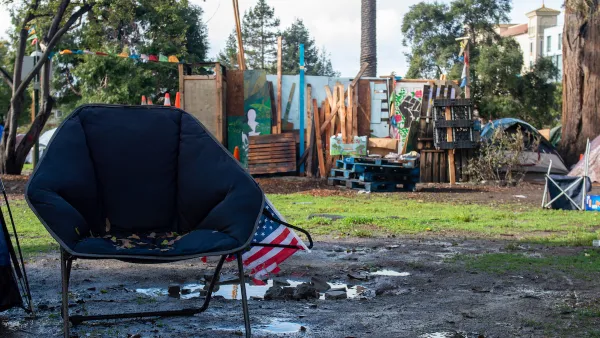
UC Berkeley Says Supportive Housing ‘Inseparable’ Part of People’s Park Project
The park remains closed to the public as a court weighs a decision on the university’s proposed housing development.

Planetizen Federal Action Tracker
A weekly monitor of how Trump’s orders and actions are impacting planners and planning in America.

The state-sanctioned urbicide of Austin
People don’t kill cities. Freeways do.

US to reduce Colorado River water deliveries to Mexico
A new Colorado Treaty amendment reduces Mexico’s Colorado River water allocation by 250,000 acre feet.

Mamdani overhauls NYC's Vision Zero plan with 100 new policy goals
The overhaul aims to reduce traffic deaths and make streets safer for pedestrians, cyclists and drivers through lower speed limits, new safety infrastructure and more.

Amtrak not solely to blame for New Jersey commuter rail's unreliability, report finds
A new study from the Garden State Initiative found that NJ Transit’s budget grew 20% across a 4 year period, but reliability declined significantly over the same period.

EPA erases limits on planet-warming pollution from power plants
Under Monday’s plan, power plants would still have some limits on how much mercury, arsenic and other contaminants they can emit.

FREE Course: Walkable City 1: Why Walkability?
After describing his path towards focusing on walkability as the essence of good planning, Jeff Speck marches through his five principal reasons for making more walkable places.
Reinventing Malls: Planning Alchemy—Turning Gray Fields Into Gold
The course focuses on the opportunities and imperatives that shape reinvention of mall sites.

Eagle County Government
Harvard University Graduate School of Design
Nashville Planning Department
The Architects Foundation
University of Cincinnati Online
The Pocatello Development Authority
The Urban Renewal Agency of the City of Pocatello
Journal of the American Planning Association