Transportation experts warn that mandatory helmet laws for shared e-scooters could cripple the nascent industry and discourage casual rides.


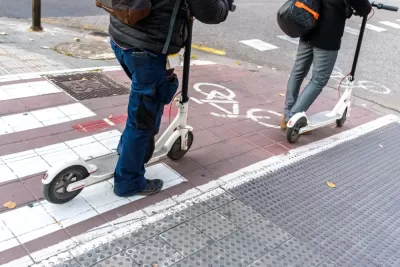
With Miami becoming the largest U.S. city to implement a helmet law for e-scooter riders, some micromobility advocates warn that the mandate will stunt the growth of the industry and impose an undue barrier that will discourage ridership, reports Jason Plautz. E-scooter supporters worry that despite initiatives on the part of operators to distribute helmets, the requirement will lead to reduced scooter trips when people inevitably forget their helmets at home or want to take an unplanned ride.
Unlike past attempts to impose helmet laws, scooter operators are not fighting the mandate, saying they will ramp up existing efforts to incentivize voluntary helmet use and work with cities to prioritize safety and find effective ways to distribute helmets and enforce regulations. To ensure compliance, operators Bird and Helbiz have introduced a feature that requires riders to take a photo of themselves wearing a helmet before starting a ride. Operators also plan to place helmets with their vehicles, but distribution strategies have proven difficult. Wheels, which touts its "safety-first" approach, redesigned its devices to accommodate helmets in 2019.
Yet transportation experts point out that despite the benefits of individual helmet-wearing, top-down mandates often "do more harm than good." Seattle's Pronto bike share system, which shut down in 2017, saw drastically reduced ridership after a helmet law was instituted in that city. For transportation advocates, safety begins with infrastructure.
FULL STORY: Scooter helmet laws pit safety against accessibility


The Electric Scooter Rebound
The nascent electric scooter rental industry came close to total collapse during the pandemic, but riders are back in bigger numbers than ever and the companies hope to build momentum on growing concerns about the climate impacts of transportation.

Miami Reinstates E-Scooter Program
After abruptly ending its shared e-scooter program last month, Miami is letting the devices return to its streets–with some new rules.

E-Scooters Are Coming to New York City
Major micromobility comapnies and lesser known competitors are stating their interest to take part in a New York City e-scooter pilot program slated for Spring 2021.

The state-sanctioned urbicide of Austin
People don’t kill cities. Freeways do.

US to reduce Colorado River water deliveries to Mexico
A new Colorado Treaty amendment reduces Mexico’s Colorado River water allocation by 250,000 acre feet.

New Jersey’s second-largest city bans standalone data centers
Jersey City will continue to allow co-location facilities, such as those meant for research institutions that store their own data.

Amtrak not solely to blame for New Jersey commuter rail's unreliability, report finds
A new study from the Garden State Initiative found that NJ Transit’s budget grew 20% across a 4 year period, but reliability declined significantly over the same period.

EPA erases limits on planet-warming pollution from power plants
Under Monday’s plan, power plants would still have some limits on how much mercury, arsenic and other contaminants they can emit.

Phoenix announces new on-demand transit service, more frequent RAPID buses
Both new services will launch in October, and are part of Phoenix's Project Effective Access Solutions for Easing Congestion.

FREE Course: Walkable City 1: Why Walkability?
After describing his path towards focusing on walkability as the essence of good planning, Jeff Speck marches through his five principal reasons for making more walkable places.
Reinventing Malls: Planning Alchemy—Turning Gray Fields Into Gold
The course focuses on the opportunities and imperatives that shape reinvention of mall sites.

Eagle County Government
Harvard University Graduate School of Design
Nashville Planning Department
The Architects Foundation
University of Cincinnati Online
The Pocatello Development Authority
The Urban Renewal Agency of the City of Pocatello
Journal of the American Planning Association