Atlanta is planning to focus on night-shift workers, part of a growing consciousness around night mayors’ responsibility to everyone who shares the night, whether that’s workers, people who are homeless or leisure seekers.


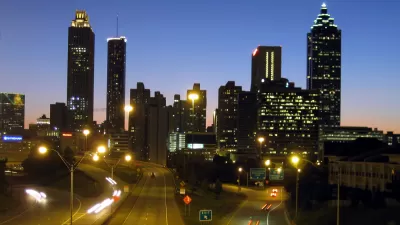
In a span of three months, four people on e-scooters were killed by a vehicle — all but one at night. That’s when Atlanta took action. The mayor enacted a nighttime ban on e-scooters that shut off the devices every day from 9 p.m. to 4 a.m.
Atlanta councilmember Amir Farokhi recalls the upset response he received when the ban was announced in 2019, reports Adina Solomon.
“I got a bunch of emails from people who work at night and got off at like 11, 12 o’clock, saying, ‘Hey, I was using the scooter to get home or to get to the train station. Now I can’t use it anymore,’” he says.
Two years later, the ban is still in place and a micro-mobility option is denied to anyone out after 9 p.m. It’s clear to Farokhi now: This is the kind of situation that calls for a night mayor, a city official who oversees activities and addresses issues that happen overnight. He proposed the idea of Atlanta hiring a night mayor. In October, this got a step closer to realization when the city council approved a feasibility study looking at the prospect.
Since the first night mayor was elected in Amsterdam in 2012, more cities around the world have created the position too. This is especially true in Europe and the U.S. Oftentimes, night mayors concentrate on nightlife and entertainment. But in addition to those elements, Atlanta is planning to focus on night-shift workers.
It’s part of a growing consciousness around night mayors’ responsibility to everyone who shares the night, whether that’s workers, people who are homeless or leisure seekers.
“There’s a much broader spectrum of stuff that happens at night in a city,” Farokhi says. “In a really vibrant city, there’s a fully-fledged nighttime economy, which frankly doesn’t get the same attention that the daytime economy gets.”
Read the full story: Atlanta’s Night Mayor Will Govern More Than Parties

Learning loss and urban schools, part 2
Did test scores in progressive cities drop more post-COVID than test scores in moderate ones?

Atlanta City Council unanimously backs $3.5 billion Beltline light rail project
The resolution was drafted after Atlanta Mayor Andre Dickens pulled support for the Atlanta Streetcar extension last year.
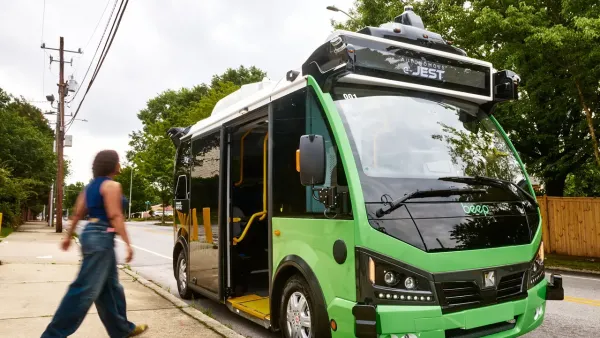
Atlanta Beltline’s free automated shuttle expands service
A $1.75 million grant funded the autonomous shuttle service’s growth.

Planetizen Federal Action Tracker
A weekly monitor of how Trump’s orders and actions are impacting planners and planning in America.

Eastern Nebraska is running out of electricity
Data centers and electrification are straining eastern Nebraska’s grid, throttling economic development.

Study reveals best places in the U.S. for cycling, walking
New research from Streetlight Data examines bicycle and pedestrian miles per capita in the 100 largest U.S. cities by population.

Next-generation nuclear reactors are coming to Texas
The reactors will not require towering containment structures thanks to new safety features.

California distributes $1.3 billion to prevent transit service cuts, bolster projects
Twenty-eight projects across California received a portion of the funding.

Pennsylvania Democrats have 15 affordability, clean energy bills for flipped state Senate
Bills in consideration include a bill supporting geothermal energy and a bill supporting solar on warehouses.

FREE Course: Walkable City 1: Why Walkability?
After describing his path towards focusing on walkability as the essence of good planning, Jeff Speck marches through his five principal reasons for making more walkable places.
Reinventing Malls: Planning Alchemy—Turning Gray Fields Into Gold
The course focuses on the opportunities and imperatives that shape reinvention of mall sites.

City of Charlotte
City of Rosemead
Rutgers University, Edward J. Bloustein School of Planning and Public Policy
University of Michigan School for Environment and Sustainability (SEAS)
Hunter College, City University of New York (CUNY)
The Architects Foundation
City of Cambridge
The Pocatello Development Authority
The Urban Renewal Agency of the City of Pocatello