Neighborhoods in urban cores are seeing the highest rates of new apartment construction in the last five years, signaling a continued interest in downtown living despite fears of an 'urban exodus' brought on by the pandemic.


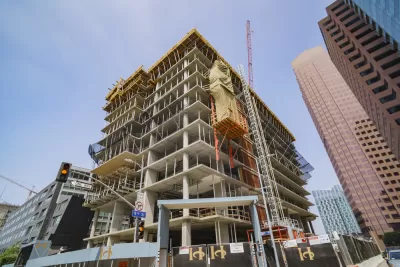
A recent analysis by RentCafe shows that 'hyper-urban' downtown neighborhoods have seen the most active apartment construction in the last five years, reports Florentina Sarac.
"Despite the fact that downtown areas haven’t always been desirable places to live in, that has certainly changed in the last decade," writes Sarac. The article lists the top 20 neighborhoods for apartment construction in the U.S., led by downtown Los Angeles with 10,136, or a whopping 39% of the city's new apartment supply and twice as many apartments as any other neighborhood. Other popular areas include Midtown Atlanta, Hunters Point in Queens, New York, and Downtown Fort Worth, Texas. The neighborhood with the highest share of new apartments in its city was San Jose, California, where tech workers continue to fuel an intensely competitive housing market.
These numbers show that despite concerns about COVID-19 transmission, urban cores remain attractive places to live. Once the bastion of 9-to-5 workers, some experts say central business districts will likely transform into multi-purpose neighborhoods as the demand for physical office space falls.
Read the full story: Apartment-Crazed Neighborhoods: The Nation’s Downtowns See Historic Boom, with DTLA Leading the Way
Major US Cities Still Suffering Downtown Decline
Research shows that the “donut effect” hollowing out central business districts since the pandemic continues to cause economic decline in the 12 largest American cities.
Office Landlords Luring Tenants Back With Incentives
Landlords are offering generous incentives in an effort to prop up the struggling U.S. office market.
Controversial Texas housing law has 'directly facilitated' over 1,250 new homes
SB 840 allows developers to build multifamily housing by-right on lots zoned for commercial use without applying to a zoning change.

Planetizen Federal Action Tracker
A weekly monitor of how Trump’s orders and actions are impacting planners and planning in America.

California plans to bury El Niño’s downpour
If the state plays its cards right, it may be able to store a billion acre-feet of El Niño’s water in aquifers.

Desperate measures: Advocates weigh draining Lake Powell to fill Colorado River
Draining the reservoir could reduce evaporation losses by a couple hundred thousand acre-feet.

Mamdani’s pied-à-terre tax survives legal challenge
A panel of judges found that the plaintiffs failed to demonstrate injury as a result of New York City's implementation of the tax.

Eastern Nebraska is running out of electricity
Data centers and electrification are straining eastern Nebraska’s grid, throttling economic development.

Seattle passes record-breaking transit services expansion
Proposition 1 will double the city’s transit tax to add 95,000 more bus trips and preserve 180,000 bus trips annually.

FREE Course: Walkable City 1: Why Walkability?
After describing his path towards focusing on walkability as the essence of good planning, Jeff Speck marches through his five principal reasons for making more walkable places.
Reinventing Malls: Planning Alchemy—Turning Gray Fields Into Gold
The course focuses on the opportunities and imperatives that shape reinvention of mall sites.

City of Rosemead
Rutgers University, Edward J. Bloustein School of Planning and Public Policy
One Hundred Miles
University of Michigan School for Environment and Sustainability (SEAS)
Hunter College, City University of New York (CUNY)
The Architects Foundation
City of Cambridge
Montrose County
The Pocatello Development Authority