Longtime residents are being left behind by new development that has raised housing costs and property taxes for some of Houston's most vulnerable communities, according to an article in the Houston Chronicle.


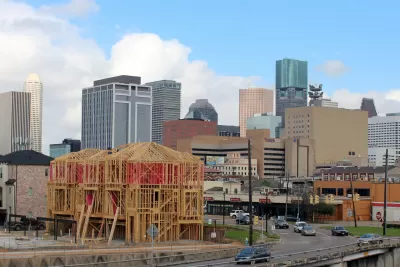
Rapid redevelopment in Houston's Fifth Ward threatens the future of the historically Black community, many of whose residents have already been displaced. As R. A. Schuetz reports, "[t]he median home sales price in the neighborhood has risen to $335,000 in 2020 from $145,000 in 2010, according to Houston Association of Realtors data," and encroaching development has led local institutions such as churches to consider relocating.
"Fifth Ward, like many historic Black and Latino neighborhoods, has also seen drops in its minority population." The upcoming East River development "has already begun construction on a golf course and will eventually bring over a million square feet of apartments, offices, restaurants and retail. Its developer, Midway, has promised that 15 percent of its housing will be affordable." But "[t]he most affordable of East River’s units will target households making 80 percent of the Houston region’s median income — that’s $63,050 for a family of four. That’s more than double Fifth Ward’s median household income of roughly $30,000."
Harvey Clemons Jr., one of the founders of Fifth Ward Community Redevelopment Corporation, "advised longtime residents to love their new neighbors and for legislators to think of ways to change the tax rules so that people who grew up there are not priced out." Clemons warns that "[t]o romanticize antiquity is an error," and "the only course [in the face of redevelopment] is to look forward."
FULL STORY: Nowhere else to go': Whether Fifth Ward residents want it or not, East River is coming [paywall]

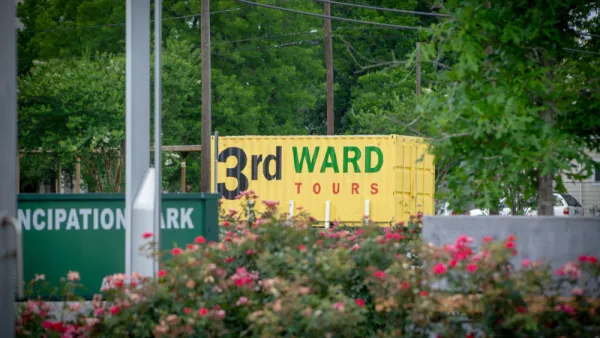
A Tour of Houston's Rapidly Gentrifying Neighborhoods
These Houston communities have experienced the most dramatic demographic changes in the last decade, according to new Census data.

20 Years After Katrina, New Orleans is More Unaffordable Than Ever
The city’s post-hurricane redevelopment has failed to include its most vulnerable residents.

Placemaking in the Barrio: Conceptualizing Infill Development in Disenfranchised Communities
How one San Antonio neighborhood could approach sustainable revitalization while supporting the existing community and drawing on its rich and diverse history and cultural resources.

Planetizen Federal Action Tracker
A weekly monitor of how Trump’s orders and actions are impacting planners and planning in America.

The state-sanctioned urbicide of Austin
People don’t kill cities. Freeways do.

US to reduce Colorado River water deliveries to Mexico
A new Colorado Treaty amendment reduces Mexico’s Colorado River water allocation by 250,000 acre feet.

Mamdani overhauls NYC's Vision Zero plan with 100 new policy goals
The overhaul aims to reduce traffic deaths and make streets safer for pedestrians, cyclists and drivers through lower speed limits, new safety infrastructure and more.

Amtrak not solely to blame for New Jersey commuter rail's unreliability, report finds
A new study from the Garden State Initiative found that NJ Transit’s budget grew 20% across a 4 year period, but reliability declined significantly over the same period.

EPA erases limits on planet-warming pollution from power plants
Under Monday’s plan, power plants would still have some limits on how much mercury, arsenic and other contaminants they can emit.

FREE Course: Walkable City 1: Why Walkability?
After describing his path towards focusing on walkability as the essence of good planning, Jeff Speck marches through his five principal reasons for making more walkable places.
Reinventing Malls: Planning Alchemy—Turning Gray Fields Into Gold
The course focuses on the opportunities and imperatives that shape reinvention of mall sites.

Eagle County Government
Harvard University Graduate School of Design
Nashville Planning Department
The Architects Foundation
University of Cincinnati Online
The Pocatello Development Authority
The Urban Renewal Agency of the City of Pocatello
Journal of the American Planning Association