The fund will invest $6 million in community-led projects aimed at public space activation, digital equity, and other recovery strategies.


"The Seattle Office of Economic Development (OED) announced the debut of its Neighborhood Economic Recovery Fund, which will support community-led strategies such as public and commercial space activation, digital equity, outreach and other economic recovery projects that respond to the specific economic and community needs of neighborhoods across Seattle." As reported by Natalie Bicknell Argerious, the fund "will invest over $6 million through direct grants to neighborhood business district organizations and other community-based organizations," $1.2 million of which will be awarded through a Request for Proposals (RFP) process. According to a press release from Pamela Banks, Interim Director of OED, "[t]he Neighborhood Recovery Fund is aimed at 'partnering with our organizations already doing this work and welcoming the new ideas of others that are willing and ready to contribute to our collective recovery efforts.'"
In Seattle, "lower-income and BIPOC (Black, Indigenous, people of color) residents have been disproportionately impacted by the pandemic, a trend that extends to the small businesses they own. Experts fear that the pandemic recovery is exacerbating income inequality — similar to what occurred after the Great Recession." In addition to public space activation and digital equity, the grants will focus on communications infrastructure development, physical improvements, community safety, and outreach projects. "According to the OED, eligible applicants include business, community, cultural or arts organizations, cultural districts, and small businesses such as community event producers, artists, consultants or a collection of individuals supporting neighborhood strategies with broadly shared benefits."
FULL STORY: Seattle’s Neighborhood Recovery Fund Open for Proposals

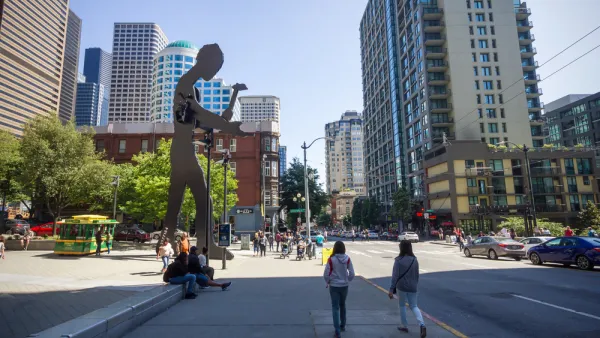
Seattle Downtown Plan Focuses on Public Safety, Programming
The mayor issued a 12-point plan for improving safety, developing services for people struggling with addiction, and revitalizing downtown spaces.

How Downtown Public Space Investments Impact Equity
Efforts to revitalize declining downtowns have, in some cases, become catalysts for supporting small, minority-owned, local businesses.
Seattle Extends Outdoor Dining for a Year, Eases Rules on Heaters for the Winter
Outdoor dining is going to hang out for a bit.

Planetizen Federal Action Tracker
A weekly monitor of how Trump’s orders and actions are impacting planners and planning in America.

The state-sanctioned urbicide of Austin
People don’t kill cities. Freeways do.

US to reduce Colorado River water deliveries to Mexico
A new Colorado Treaty amendment reduces Mexico’s Colorado River water allocation by 250,000 acre feet.

5 New England states march closer to 800 megawatt wind energy project
Securing federal approval for the project may be complicated under the Trump administration, which has historically been hostile towards domestic wind power.

Baltimore to break ground on $50 million Transit Priority Project
The project will bring faster bus trips, safer streets and better bike connections to Baltimore.

Airbnb launches $250 million 'last-dollar financing' housing accelerator, makes first investment in Austin
The company will put $6.4 million towards affordable housing development in Texas’ capital.

FREE Course: Walkable City 1: Why Walkability?
After describing his path towards focusing on walkability as the essence of good planning, Jeff Speck marches through his five principal reasons for making more walkable places.
Reinventing Malls: Planning Alchemy—Turning Gray Fields Into Gold
The course focuses on the opportunities and imperatives that shape reinvention of mall sites.

Eagle County Government
Harvard University Graduate School of Design
Nashville Planning Department
The Architects Foundation
University of Cincinnati Online
The Pocatello Development Authority
The Urban Renewal Agency of the City of Pocatello
Journal of the American Planning Association