The walkway is simpler and faster to build than a sidewalk, letting the city quickly and cost-effectively improve pedestrian safety on important walking corridors.


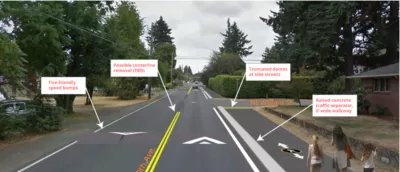
The city of Portland is experimenting with a new type of pedestrian walkway that could "improve walking conditions without the expense or complication of building a full-fledged sidewalk." Jonathan Maus of Bike Portland reports on the "alternative pedestrian walkway," a one-mile pilot project on Portland's Northeast 60th Avenue.
"Identified as a major walking corridor in the city’s pedestrian master plan (Ped PDX, 2019), 60th was like many streets in Cully and other less-developed parts of Portland: it had two general lanes and no space for shoulders, bike lanes or sidewalks. To get the space for a six-foot wide walkway on one side of the street, PBOT shifted the centerline over about four feet. They then leveled and paved the existing gravel shoulder." The walkway is marked with pedestrian markings and crossings feature "zebra-striping, truncated domes (those tiny yellow bumps), and a few plastic delineator wands."
Although not designed as a bikeway, use by bicycles is allowed. "Until PBOT establishes good bikeways nearby, this could become a useful bikeway." The project provides a template for quick, low-cost pedestrian improvements.
Read the full story: First Look: Portland’s novel ‘alternative pedestrian walkway’

The number of kids walking to school dropped from over 50% to 11% since the 1960s
Unsafe pedestrian infrastructure makes walking to school dangerous or impossible for a growing number of American students.
St. Petersburg Launches Sidewalk Master Plan to Close Gaps in Pedestrian Network and Improve Accessibility
The plan will inform priorities for fiscal year 2027.

Jeff Speck’s “Interesting Walk,” In Unexpected Art Forms
We thought it would be fun to ask the Planetizen family to show us their version of the Interesting Walk. What we got back surprised and delighted us beyond expectation.

Planetizen Federal Action Tracker
A weekly monitor of how Trump’s orders and actions are impacting planners and planning in America.

California plans to bury El Niño’s downpour
If the state plays its cards right, it may be able to store a billion acre-feet of El Niño’s water in aquifers.

Desperate measures: Advocates weigh draining Lake Powell to fill Colorado River
Draining the reservoir could reduce evaporation losses by a couple hundred thousand acre-feet.

In Texas, data centers are swallowing promised parkland
Residents who moved to Taylor, Texas for a rural community now have to contend with three data centers in their backyard.

How a Chicago-sized wind farm beat the odds and powered on
The project spanned five presidential administrations and a standoff with a U.S. military base.

MTA gives itself 30 days to transform pit into basketball court
The site has been under construction since 2022; the city originally estimated it would finish the court in 2024.

FREE Course: Walkable City 1: Why Walkability?
After describing his path towards focusing on walkability as the essence of good planning, Jeff Speck marches through his five principal reasons for making more walkable places.
Reinventing Malls: Planning Alchemy—Turning Gray Fields Into Gold
The course focuses on the opportunities and imperatives that shape reinvention of mall sites.

City of Rosemead
Rutgers University, Edward J. Bloustein School of Planning and Public Policy
One Hundred Miles
Hunter College, City University of New York (CUNY)
The Architects Foundation
University of Cincinnati Online
City of Cambridge
Montrose County
The Pocatello Development Authority