Examples from around the world showing that the popular theory often doesn't hold up present powerful implications for commons management.



The concept of the "tragedy of the commons," developed in 1968 by Garrett Hardin, goes like this: "humans, when left to their own devices, compete with one another for resources until the resources run out." Writing in Aeon, Michelle Nijhuis argues that this popular theory, which has since "provided a temptingly simple explanation for catastrophes of all kinds," is "a false and dangerous myth."
Political scientist Elinor Ostrom, who went on to win the Nobel Prize in Economic Sciences in 2009—decades after her pioneering research—found examples from around the world that contradicted Hardin's hypothesis that "[f]reedom in a commons brings ruin to all."
"While Hardin speculated that the tragedy of the commons could be avoided only through total privatisation or total government control, Ostrom had witnessed groundwater users near her native Los Angeles hammer out a system for sharing their coveted resource. Over the next several decades, as a professor at Indiana University Bloomington, she studied collaborative management systems developed by cattle herders in Switzerland, forest dwellers in Japan, and irrigators in the Philippines. These communities had found ways of both preserving a shared resource – pasture, trees, water – and providing their members with a living."
The successful communities, Ostrom observed, featured some similarities: "clear boundaries (the ‘community’ doing the managing must be well-defined); reliable monitoring of the shared resource; a reasonable balance of costs and benefits for participants; a predictable process for the fast and fair resolution of conflicts; an escalating series of punishments for cheaters; and good relationships between the community and other layers of authority, from household heads to international institutions."
Ostrom's research has powerful implications for the field of commons management, an increasingly important aspect of a globalized world facing the threat of destabilizing climate change and other conservation challenges. "While conservation almost always carries at least some short-term costs, researchers have found that many community-based conservation projects reduce those costs and, over time, deliver significant benefits to their human participants, tangible and intangible alike."
Read the full story: The miracle of the commons

A Win for ‘Keep it in the Ground’
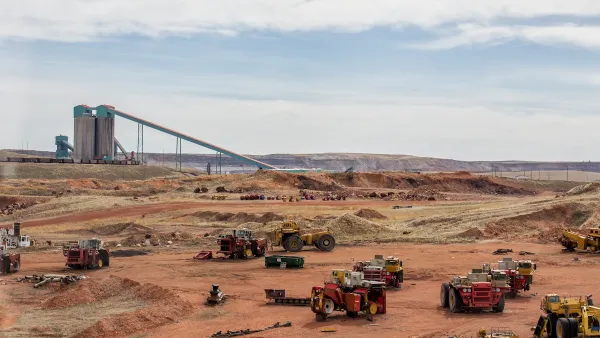
Coal mining in Wyoming will take a major hit as a result of a U.S. Department of Interior plan to cease future leasing of coal mines in the nation's most productive coal mining basin. The decision casts a spotlight on the presidential election.

Tolling All Lanes
Bay Area transportation planners are studying a radical idea to reduce traffic congestion and fund driving alternatives: tolling all lanes on a freeway. Even more radical, the plan considers tolling parallel roads.

Initiative Brings Capacity Building to Booming Rural Towns
A research and capacity building initiative based at Utah State University seeks to help fast-growing tourist meccas in the West plan for smart growth.

Planetizen Federal Action Tracker
A weekly monitor of how Trump’s orders and actions are impacting planners and planning in America.

The state-sanctioned urbicide of Austin
People don’t kill cities. Freeways do.

Colorado’s Largest Data Center Could Rise Next to Homes — Without a Public Hearing
The proposed campus would consume 11 times the power of Denver International Airport; as it has across the country, opposition mounts.

Nation's most wind-powered state turns to coal as data centers increase energy demand
For the first time in decades, Iowa has increased its generation of coal power.

NYC cools commuters with city's first rain garden above a bus stop
New York City officials say the plants in the rain garden can absorb 16 gallons of rainwater during heavy storms.

Brightline West’s future may rely on $6 billion federal loan
The company has until Nov. 2 to make a $400 million equity investment into its proposed high-speed rail line.

FREE Course: Walkable City 1: Why Walkability?
After describing his path towards focusing on walkability as the essence of good planning, Jeff Speck marches through his five principal reasons for making more walkable places.
Reinventing Malls: Planning Alchemy—Turning Gray Fields Into Gold
The course focuses on the opportunities and imperatives that shape reinvention of mall sites.


Greater Baltimore Committee
Eagle County Government
Harvard University Graduate School of Design
The Architects Foundation
University of Cincinnati Online
The Pocatello Development Authority
The Urban Renewal Agency of the City of Pocatello
Journal of the American Planning Association