The city hopes for "transformative" solutions to reinvigorate the auto-centric parkway and create safer paths for people walking and biking.


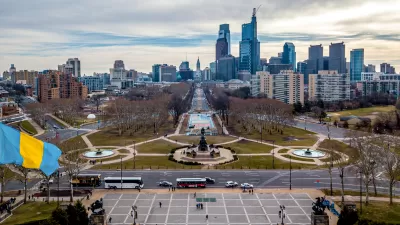
Philadelphia is seeking proposals to redesign the Benjamin Franklin Parkway with a stronger focus on bike and pedestrian infrastructure, reports Ryan Briggs for WHYY. "The joint RFP, filed by the Department of Parks and Recreation, the Office of Transportation Infrastructure and Sustainability and the Mayor’s Fund, calls for a total redo of Eakins Oval –– including the removal of a surface parking lot –– and better infrastructure for public gatherings." City leaders want to make the space between Logan Circle and the Philadelphia Art Museum a more accessible, more usable "pedestrian-oriented civic space."
Similar projects have added "scattered—and sometimes temporary—improvements" along other stretches of the parkway, and officials hope the new project will unify what Parks and Rec Commissioner Kathryn Ott Lovell calls Philadelphia's "Champs-Élysées." The Parisian boulevard, in fact, heavily influenced the 1917 design for the Franklin Parkway. But the road has become increasingly hostile to pedestrians. "Subsequent redesigns grappled with a complex traffic pattern that included intersections with Kelly Drive, Martin Luther King Drive, the Spring Garden Bridge, and other city streets. The construction of interstates 76 and 676 in the later 20th century added dedicated highway ramp spurs along the southern portions of the Parkway, further complicating foot access."
With the project in its earliest stages, the city says it is "open to ambitious solutions" and hopes to see some "transformative ideas" for the historic roadway.
Read the full story: Philly’s iconic Ben Franklin Parkway to get a major redesign

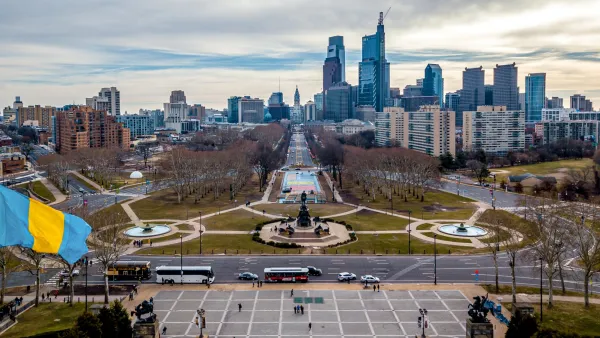
Philadelphia Launches Plan To Redesign Ben Franklin Parkway
The city wants to make the car-centric parkway more accessible and people-friendly.
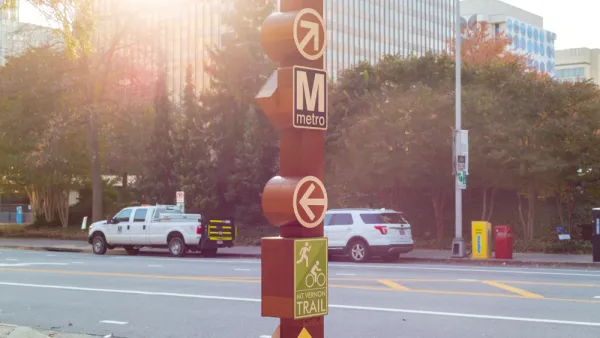
Quality Bike Infrastructure Saved Lives During the Pandemic, Study Says
Evidence from Arlington, Virginia.
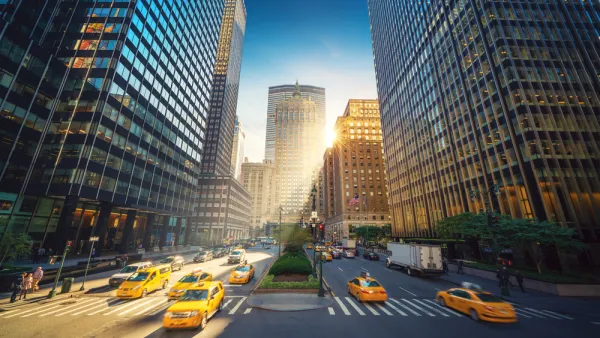
The Once and Future Park Avenue Promenade
The debate about whether the pedestrian-oriented changes made to the New York City streetscape during the pandemic should be permanent has a high-profile battleground on Park Avenue.

Planetizen Federal Action Tracker
A weekly monitor of how Trump’s orders and actions are impacting planners and planning in America.

The state-sanctioned urbicide of Austin
People don’t kill cities. Freeways do.

US to reduce Colorado River water deliveries to Mexico
A new Colorado Treaty amendment reduces Mexico’s Colorado River water allocation by 250,000 acre feet.

Nation's most wind-powered state turns to coal as data centers increase energy demand
For the first time in decades, Iowa has increased its generation of coal power.

NYC cools commuters with city's first rain garden above a bus stop
New York City officials say the plants in the rain garden can absorb 16 gallons of rainwater during heavy storms.

Brightline West’s future may rely on $6 billion federal loan
The company has until Nov. 2 to make a $400 million equity investment into its proposed high-speed rail line.

FREE Course: Walkable City 1: Why Walkability?
After describing his path towards focusing on walkability as the essence of good planning, Jeff Speck marches through his five principal reasons for making more walkable places.
Reinventing Malls: Planning Alchemy—Turning Gray Fields Into Gold
The course focuses on the opportunities and imperatives that shape reinvention of mall sites.


Eagle County Government
Harvard University Graduate School of Design
Nashville Planning Department
The Architects Foundation
University of Cincinnati Online
The Pocatello Development Authority
The Urban Renewal Agency of the City of Pocatello
Journal of the American Planning Association