Contrary to popular myth, the disabled drive less than other Americans.



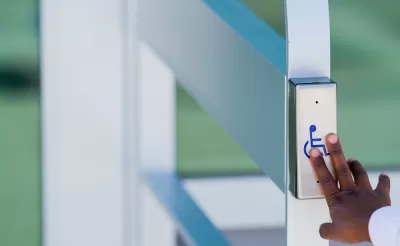
One common argument against virtually any policy that might inconvenience drivers is that disabled people cannot walk and thus need to drive, and that pro-pedestrian policies therefore constitute ableism. It seems to me this argument is based on a certain stereotype of disabled Americans: as middle-class car-owning senior citizens whose disability requires a wheelchair, and who never walk, and who cannot rely on public transit. But a 2017 Bureau of Transportation Statistics (BTS) survey shows that this stereotype is inaccurate in a variety of ways.
First of all, the majority of Americans who have a transportation-limiting disability are under 65: out of 25 million Americans with a mobility-related disability, only 11.2 million are over 65. Only 11.6 percent of Americans with mobility-related disabilties (or "MDs" for short) use wheelchairs, about half the percentage of MDs who use walkers (22.9 percent) and one-third the number who use canes (36.7 percent). 42.2 percent of MDs use no medical devices at all to help them get around.
Second, most younger MDs are not middle-class. More than half of under-65 MDs live in households with incomes under $25,000, and only 20 percent of them work at all (as opposed to three-quarters of other Americans under 65). Almost half of this 20 percent (46.8 of them) work part-time. (Because many over-65 Americans are retired, I suspect that transportation-disabled seniors are even less likely to work; however, the study adds no data relevant to this point.)
Not surprisingly, many of these disabled Americans do not drive. Nearly 40 percent of MDs do not drive cars themselves, as opposed to 8.3 percent of nondisabled Americans. Many of these people, of course, live with someone who does drive. Even so, MDs are more likely to be car-free than the rest of us: 22.5 percent of all nonworking MDs under 65 live in households without cars, as do 12.2 percent of the minority of MDs who work. In each of these categories, MDs are more likely to be in zero-vehicle households than nondisabled Americans. For example, only 3.9 percent of non-disabled, employed workers under 65 live in zero-vehicle households.
As a result, MDs are less likely to use cars for most trips than their non-disabled counterparts. Employed MDs under 65 drive themselves on 54.5 percent of trips, while nearly three-quarters of nondisabled workers under 65 do so. Nonworking MDs do so for only 42.6 percent of trips, as opposed to only 58.3 percent of non-disabled unemployed. MDs get rides from other drivers, however, for a little over 1/4 of all their trips (31 percent for nonworkers, 23.5 percent for workers).
Even though many transportation-disabled Americans have difficulty walking, they are still more likely to walk to most trips than the non-disabled. According to BTS, employed MDs "walk for a slightly greater share of trips than workers without disabilities (14.6 v. 13.0 percent)".
Because not all buses and trains comply with the Americans with Disabilities Act, one might think that disabled people are less likely to use public transportation than other Americans. But this is not the case. Employed MDs under 65 use local transit on 4.3 percent of all trips, as opposed to 2.7 percent for their nondisabled counterparts. Similarly, nonworking MDs under 65 use transit for 5.9 percent of all trips, as opposed to 3.3 percent for their nondisabled counterparts. This data does not include paratransit, which is used far less frequently; roughly 1.5 percent of trips by transportation-disabled Americans are on paratransit. Thus, the notion that paratransit is a useful substitute for local transit seems to be incorrect, at least for many disabled Americans.
What about the seniors with mobility impairments? Surely one might think that they drive more than anyone else, since the ability to walk declines with age. This is only partially true: even though senior MDs are driven around more than the younger disabled, they are not significantly more likely to drive than non-disabled seniors. Senior MDs drive themselves for only 47.8 percent of all trips (compared to 69.3 percent for non-disabled seniors).
Senior MDs use public transit less than younger MDs, but they nevertheless do so more than non-disabled seniors: they use local transit for 2.8 percent of all trips, while nondisabled seniors use transit for 1.8 percent of trips. Senior MDs use paratransit less than nonseniors; they only use it for 0.9 percent of all trips—additional evidence that paratransit is not a substitute for traditional public transit.*
In sum, the disabled are less likely to own cars than other Americans, more likely to use buses and trains, and about equally likely to walk. So if we want more equity for the disabled, we should make walking and public transit easier.
*This does not mean that paratransit is unnecessary. The purpose of paratransit is to serve people who cannot use traditional transit- so the minority of disabled who use paratransit really, really need it.
TriMet will eliminate 'Hand-to-Hand' paratransit service for half of its users
Roughly 300 Portland-area paratransit riders will lose access to a program that lets drivers escort them into their destination.
Denver Advocates Sue RTD for Charging People With Disabilities for On-demand Transit
The suit argues the agency is violating the rights of Americans with disabilities while lowering fares for other riders.
Texas DOT Approves $96M in Transit Funding
The funds will be apportioned between 64 transit agencies around the state.

Planetizen Federal Action Tracker
A weekly monitor of how Trump’s orders and actions are impacting planners and planning in America.

California plans to bury El Niño’s downpour
If the state plays its cards right, it may be able to store a billion acre-feet of El Niño’s water in aquifers.

Desperate measures: Advocates weigh draining Lake Powell to fill Colorado River
Draining the reservoir could reduce evaporation losses by a couple hundred thousand acre-feet.

In Texas, data centers are swallowing promised parkland
Residents who moved to Taylor, Texas for a rural community now have to contend with three data centers in their backyard.

How a Chicago-sized wind farm beat the odds and powered on
The project spanned five presidential administrations and a standoff with a U.S. military base.

MTA gives itself 30 days to transform pit into basketball court
The site has been under construction since 2022; the city originally estimated it would finish the court in 2024.

FREE Course: Walkable City 1: Why Walkability?
After describing his path towards focusing on walkability as the essence of good planning, Jeff Speck marches through his five principal reasons for making more walkable places.
Reinventing Malls: Planning Alchemy—Turning Gray Fields Into Gold
The course focuses on the opportunities and imperatives that shape reinvention of mall sites.

City of Rosemead
Rutgers University, Edward J. Bloustein School of Planning and Public Policy
One Hundred Miles
Hunter College, City University of New York (CUNY)
The Architects Foundation
University of Cincinnati Online
City of Cambridge
Montrose County
The Pocatello Development Authority

