A drastic and unprecedented measure included in the draft Plan Bay Area 2050, released this summer, would require 60 percent of all workers in Bay Area office jobs to telecommute.


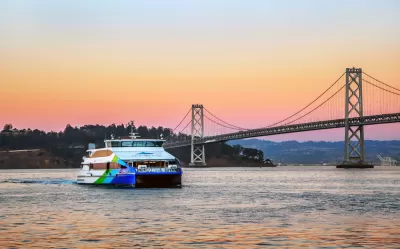
"In the face of protests from San Francisco officials and advocates of public transit, the Metropolitan Transportation Commission on Wednesday moved forward with a plan to keep many of the region’s workers at home — with climate change, not the coronavirus pandemic, as the rationale," reports Roland Li in a paywalled article for the San Francisco Chronicle.
Specifically, the MTC "voted to include the controversial mandate that large Bay Area employers keep 60% of their workers home each workday as part of a 2050 planning strategy to reduce greenhouse gas emissions and traffic congestion," according to Li.
An article by Laura Bliss for Bloomberg CityLab provides additional analysis of the implications of mandated telecommuting policies.
"The remote-work order is one of 35 strategies in Plan Bay Area 2050, the group’s 30-year roadmap to guide regional transportation funding, as required by state and federal law. The work-from-home directive aims to bring the region’s climate-changing carbon emissions down," writes Bliss to summarize the MTC's rationale for the work-from-home mandate.
The MTC released the draft Plan Bay Area 2050 in July of this year, but the telecommute mandate escaped scrutiny at the time. More detail on the mandate follows:
The 60% benchmark for office workers was designed to bring the telecommute share of the region’s overall workforce as high as 25%, Matt Maloney, the commission’s regional planning director, said during the meeting. With a goal to achieve a 19% reduction in per capita greenhouse gases by 2035, the blueprint’s strategies “must be ones that local governments are poised to deliver,” he said. The telecommuting strategy, Maloney said later, was “one of the most necessary pieces.”
The plan did provoke criticism during its hearing, according to Bliss.
Nick Josefowitz, an MTC commissioner who works as the director of policy at the urbanism think tank SPUR, said that such a mandate would end up punishing workers who share crowded homes with roommates and family members, especially in an exorbitantly expensive housing market with scant inventory. He also questioned the emphasis on telecommuting rather than on non-polluting modes of transport, and warned of impacts on businesses and government coffers that rely on daily infusions of workers.
Bliss's coverage provides many more soundbites from the debate surrounding the telecommuting mandate, and also adds some perspective about the limitations of Plan Bay Area 2050, which would require enabling legislation to enforce each of its many components. "Still, a government-backed work-from-home policy at this scale would be a first for U.S. climate policy, and the mandate’s appearance on this planning document is a landmark in a year of upheaval in the realm of transportation — and in the wake of a summer of environmental catastrophe in California," writes Bliss.
Read the full story: The Murky Case for Mass Telecommuting

Opinion: To Meet Climate Goals, Bay Area Needs More Transit-Oriented Development
The region's transit-oriented development (TOD) plan requires a significant update to achieve the density and housing goals laid out in the MTC's 30-year vision.

Plan Bay Area 2050, Approved Last Week, Makes the Opinion Page
A traditionally controversial planning exercise, the regular update of the 30-year plan for the San Francisco Bay Area, has crossed the finish line again. Opponents aren't letting the issues rest, however.
Plan Bay Area 2050 Draft Released
A regional plan for the nine-county San Francisco Bay Area is available for public comment.

Planetizen Federal Action Tracker
A weekly monitor of how Trump’s orders and actions are impacting planners and planning in America.

The state-sanctioned urbicide of Austin
People don’t kill cities. Freeways do.

Colorado’s Largest Data Center Could Rise Next to Homes — Without a Public Hearing
The proposed campus would consume 11 times the power of Denver International Airport; as it has across the country, opposition mounts.

Nation's most wind-powered state turns to coal as data centers increase energy demand
For the first time in decades, Iowa has increased its generation of coal power.

NYC cools commuters with city's first rain garden above a bus stop
New York City officials say the plants in the rain garden can absorb 16 gallons of rainwater during heavy storms.

Brightline West’s future may rely on $6 billion federal loan
The company has until Nov. 2 to make a $400 million equity investment into its proposed high-speed rail line.

FREE Course: Walkable City 1: Why Walkability?
After describing his path towards focusing on walkability as the essence of good planning, Jeff Speck marches through his five principal reasons for making more walkable places.
Reinventing Malls: Planning Alchemy—Turning Gray Fields Into Gold
The course focuses on the opportunities and imperatives that shape reinvention of mall sites.

Greater Baltimore Committee
Eagle County Government
Harvard University Graduate School of Design
The Architects Foundation
University of Cincinnati Online
The Pocatello Development Authority
The Urban Renewal Agency of the City of Pocatello
Journal of the American Planning Association