The University of Illinois at Urbana-Champaign developed a high-frequency coronavirus testing system that would be the envy of an country or corporation, testing students, faculty and staff twice a week, but it still failed to stem a major outbreak.


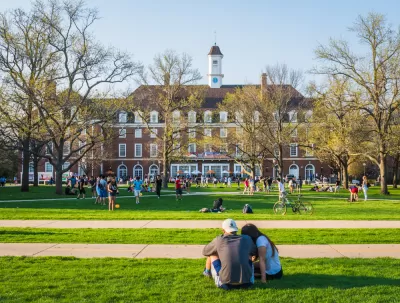
Colleges and universities throughout the country are seeing infections soar among their students, creating major tension in college towns that nervously awaited the return of students. Widespread, frequent testing plays a critical role in keeping schools open and communities safe, although it's no silver bullet by itself.
As noted in a post last month that focused on wastewater coronavirus testing, universities in the United States have the potential to effectively demonstrate COVID-containment strategies, provided the motivation and leadership are present. The University of Illinois at Urbana-Champaign (UIUC) meets that description by utilizing campus resources that may not be available to other universities.
"Researchers at the university, a science and technology powerhouse, designed a saliva test that would be easy to collect and process, to be taken twice a week," report Emma Court and Shruti Singh for Bloomberg Businessweek on Sept. 11 (source article). The test was approved by the Food and Drug Administration last month after UIUC performed a bridge study to a saliva-based COVID-19 test developed by researchers at the Yale School of Public Health that received an Emergency Use Authorization on August 15.
“Direct saliva testing can address bottlenecks of time, cost and supplies," wrote Liz Ahlberg Touchstone, the biomedical sciences editor for Campus News, which serves the University of Illinois System, on August 19.
"Our test also has unique features that enable fast and frequent testing on a large scale, and we are now working together with many partners to make our testing method broadly available as soon as possible,” said Dr. Martin Burke, a chemistry professor who helped to design the test.
Unlike most coronavirus tests, which involve a long, invasive nasopharyngeal swab, the Illinois-developed saliva test, called I-COVID, asks those tested to drool a small amount into a sterile test tube.
Rather than sending the samples to commercial labs, resulting in slow turnaround times, processing is completed in as little as five hours at the university's Veterinary Diagnostic Laboratory, write Meredith Deliso and Dr. Jay Bhatt for ABC News in one of the more comprehensive articles on the testing program.
The lab runs tests 24 hours a day on weekdays, and nearly that on weekends.
When the lab scans the barcode on the test tube, it connects to the person's medical record. The results of the test are delivered via a HIPAA-compliant secure portal or app, dubbed Safer Illinois.
Safer Illinois is essentially Wuhan comes to Urbana-Champaign: Since April, Wuhan residents without a green code on their smart phones can't access the subway.
"Developed on campus, the innovative Safer Illinois app provides users their personalized coronavirus-testing results and reminders of their scheduled testing, along with a display of their current testing status that will serve as one of the mechanisms to gain entry to university facilities during the pandemic, all without showing any personalized health information to personnel assigned to university building entrances," states an August 13 UIUC Research News blog.
Students return
"While UIUC’s example illustrates how mass screenings can identify a problem early, it also shows they aren’t enough on their own to prevent virus spread," add Court and Singh.
The widespread, mandatory testing performed on the 35,000 returning students, as well as faculty and staff, performed like a "a real-world example of the sort of public health measures many experts long have been urging: frequent testing—even of people with no symptoms—combined with contact tracing and technology-enabled exposure notifications."
With more than 255,000 tests performed, the school has done more than 5% of the state of Illinois’s total screenings so far and accounted for nearly 20% of them last week.
Yet critics—including some of the university’s own faculty—say the school has relied too heavily on its impressive technology and predictive analytics, while miscalculating about its own students, young adults still learning how to live on their own and eager for social contact after months of isolation.
“It’s not just about testing,” says David Wilson, a longtime geography professor. “It’s about people, their daily rituals and habits. That was not really considered.”
The New York Times college and university COVID tracker shows UIUC having the state's highest number of infections, 1,760 as of Sept. 10, followed by Illinois State University with 1,327. What happened?
On Sept. 2, the university sounded an alarm. Over the previous 10 days, 784 positive cases had emerged, and if the trend continued the count could rise to as many as 8,000 that semester.
The university's COVID-19 testing data dashboard shows daily new cases, which spiked on August 31, but it doesn't appear to show total, cumulative cases.
"It literally was parties on a Thursday or Friday night...and then we started seeing the rising cases, you know, three or four days after," Burke, the chemistry professor, told ABC News on Sept. 15.
"The very good news is, is that because we had this very robust fast frequent testing going on we literally saw it as it was happening," he said. "And we saw those cases rising exactly where and we knew why, so we were able to make immediate corrective actions on multiple fronts."
Implications for opening offices
"The school cracked down on parties, told undergrads to leave their homes or dorms only for essential activities such as going to class and buying food, set up a new team to isolate positive cases quicker, and created an online form to report risky behavior," noted Court and Singh.
What happens on the Illinois campus this fall will have broad implications, not just for its own community but for other reopening colleges and the U.S. at large.
While UIUC’s example illustrates how mass screenings can identify a problem early, it also shows they aren’t enough on their own to prevent virus spread. “We’ve learned fast, frequent testing can work—because we’re seeing it work as we speak,” says Burke, who leads the school’s testing and tracing program. “But we’ve also learned it’s not a silver bullet.”
Types of testing
UIUC is among a handful of colleges and universities that subjects all students to frequent, mandatory testing, Yale and Northeastern among them. More typical are less widespread protocols, such as Ohio State University, which administers a surveillance testing program that "allow[s] the university to monitor and address real-time trends and prevalence and make timely decisions on intervention and response," according to the university's Student Health Services.
A surveillance testing program means that samples of students will be selected and tested for COVID-19, regardless of whether they have a known exposure or are showing symptoms of COVID-19. This allows us to make inferences about the level of spread in the student population and identify asymptomatic cases for isolation.
In response to a query as to whether to call the testing part of COVID-19 SHIELD a surveillance testing program, since everyone, as opposed to samples, would be tested, Nigel Goldenfeld, a physics professor who’s helped with modeling, emailed that he calls it "high frequency, high-throughput deep testing of our target population." Goldenfeld referred to the three types of surveillance described by the World Health Organization, and indicated it would fit under "Accelerated Disease Control".
"The reason is that the goal is eradication," he added.
Related in Planetizen:
-
Coronavirus College Clusters Stress Town and Gown Relationship, Sept. 14, 2020
-
Coronavirus Wastewater Testing Yields Positive Results at Universities, September 1, 2020
- College Campuses Offer Opportunity to Demonstrate COVID Containment Strategies, Aug. 28, 2020
-
COVID's New Demographic, June 29, 2020
FULL STORY: It’s Hard to Keep a College Safe From Covid, Even With Mass Testing


Coronavirus Wastewater Testing Yields Positive Results at Universities
Wastewater testing is being hailed as a success at the University of Arizona, credited for stopping a COVID outbreak. In Utah, wastewater analysis forced almost 300 students to quarantine for four days while awaiting their test results.
Coronavirus College Clusters Stress Town and Gown Relationship
College towns that have been observing public health guidelines and seen relatively few COVID-19 cases are now seeing infections spike as young people return to take classes. The New York Times has been tracking cases in colleges and college towns.
College Campuses Offer Opportunity to Demonstrate COVID Containment Strategies
As college students return for the fall semester, college towns are rightfully concerned about an influx of COVID cases, yet self-contained campuses have the potential to succeed where local and state governments may have failed.

The state-sanctioned urbicide of Austin
People don’t kill cities. Freeways do.

US to reduce Colorado River water deliveries to Mexico
A new Colorado Treaty amendment reduces Mexico’s Colorado River water allocation by 250,000 acre feet.

New Jersey’s second-largest city bans standalone data centers
Jersey City will continue to allow co-location facilities, such as those meant for research institutions that store their own data.

Amtrak not solely to blame for New Jersey commuter rail's unreliability, report finds
A new study from the Garden State Initiative found that NJ Transit’s budget grew 20% across a 4 year period, but reliability declined significantly over the same period.

EPA erases limits on planet-warming pollution from power plants
Under Monday’s plan, power plants would still have some limits on how much mercury, arsenic and other contaminants they can emit.

Phoenix announces new on-demand transit service, more frequent RAPID buses
Both new services will launch in October, and are part of Phoenix's Project Effective Access Solutions for Easing Congestion.

FREE Course: Walkable City 1: Why Walkability?
After describing his path towards focusing on walkability as the essence of good planning, Jeff Speck marches through his five principal reasons for making more walkable places.
Reinventing Malls: Planning Alchemy—Turning Gray Fields Into Gold
The course focuses on the opportunities and imperatives that shape reinvention of mall sites.

Eagle County Government
Harvard University Graduate School of Design
Nashville Planning Department
The Architects Foundation
University of Cincinnati Online
The Pocatello Development Authority
The Urban Renewal Agency of the City of Pocatello
Journal of the American Planning Association