Two of the most controversial pipeline projects in the United States were dealt massive blows within the span of 24 hours.



The nation woke this morning to news that a federal judge had ruled against the Trump administration and ordered the Dakota Access Pipeline shut down and emptied of oil by August 5. An environmental impact statement for the project will be next, according to the ruling.
Amy Sisk reports:
The $3.8 billion pipeline built by developer Energy Transfer has been moving Bakken oil to a shipping point in Illinois for three years. But U.S. District Judge James Boasberg, who is overseeing the lawsuit, in March ordered the U.S. Army Corps of Engineers to complete a full Environmental Impact Statement. The question of whether the pipeline would be shut down in the meantime had lingered since.
An EIS is a much more stringent review than the Environmental Assessment the Corps completed earlier. Such a study is expected to take 13 months, Boasberg wrote in the ruling he issued Monday.
The Dakota Access Pipeline captured national media attention as environmentalists and local Native American tribes united to oppose the project, and encountered stiff resistance from authorities during the fall, winter, and spring of 2016-2017.
Just one day earlier, the developers of the Atlantic Coast Pipeline, which had won a key Supreme Court victory in June, decided to cancel the project. The Atlantic Coast Pipeline attracted controversy for proposing to cross the Appalachian Trail on its journey between West Virginia and North Carolina.
"Duke Energy and Dominion Energy said that lawsuits, mainly from environmentalists aimed at blocking the project, had increased costs to as much as $8 billion from about $4.5 billion to $5 billion when it was first announced in 2014," reports Ivan Penn on the latest development in the Atlantic Coast Pipeline's story. "Dominion also said on Sunday that it was selling all of its gas transmission and storage assets to an affiliate of Warren Buffett’s Berkshire Hathaway in a deal valued at $9.7 billion."
FULL STORY: Federal judge orders Dakota Access Pipeline shut down


Massive Tejon Ranch Development Paused; Judge Cites Wildfire, Greenhouse Gas Emissions
In the works since 1999, the Centennial Project by Tejon Ranch Co. seemed to have cleared its final hurdle in 2018, but a Los Angeles County court ruling has created another hurdle for the sprawling development.
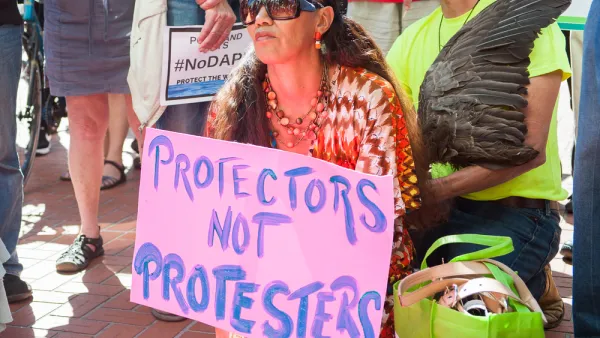
Standing Sioux Tribe Wins Court Case on Dakota Access Pipeline
A federal judge ruled that the Army Corps of Engineers failed to fully comply with NEPA in allowing the controversial pipeline to cross under the Missouri River. The judge did not order Energy Transfers Partners to cease operations of the pipeline.
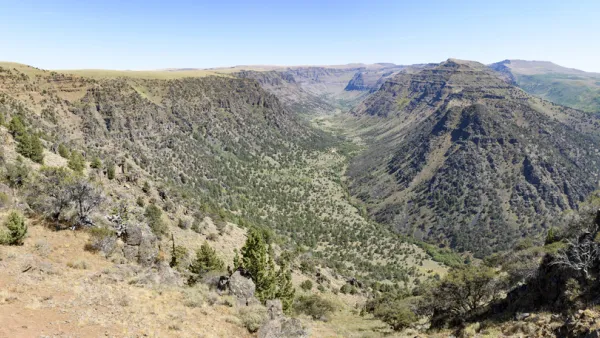
Environmentalists Defeat Wind Energy Project in Southeast Oregon
Plans for a wind energy facility have been vacated after environmentalists successfully challenged the environmental review for the project.

The state-sanctioned urbicide of Austin
People don’t kill cities. Freeways do.

US to reduce Colorado River water deliveries to Mexico
A new Colorado Treaty amendment reduces Mexico’s Colorado River water allocation by 250,000 acre feet.

New Jersey’s second-largest city bans standalone data centers
Jersey City will continue to allow co-location facilities, such as those meant for research institutions that store their own data.

Amtrak not solely to blame for New Jersey commuter rail's unreliability, report finds
A new study from the Garden State Initiative found that NJ Transit’s budget grew 20% across a 4 year period, but reliability declined significantly over the same period.

EPA erases limits on planet-warming pollution from power plants
Under Monday’s plan, power plants would still have some limits on how much mercury, arsenic and other contaminants they can emit.

Phoenix announces new on-demand transit service, more frequent RAPID buses
Both new services will launch in October, and are part of Phoenix's Project Effective Access Solutions for Easing Congestion.

FREE Course: Walkable City 1: Why Walkability?
After describing his path towards focusing on walkability as the essence of good planning, Jeff Speck marches through his five principal reasons for making more walkable places.
Reinventing Malls: Planning Alchemy—Turning Gray Fields Into Gold
The course focuses on the opportunities and imperatives that shape reinvention of mall sites.

Eagle County Government
Harvard University Graduate School of Design
Nashville Planning Department
The Architects Foundation
University of Cincinnati Online
The Pocatello Development Authority
The Urban Renewal Agency of the City of Pocatello
Journal of the American Planning Association