Renters in smaller multi-family buildings and single-family homes are faced with larger economic challenges during the pandemic, according to new analysis by researchers at the Joint Center for Housing Studies of Harvard University.


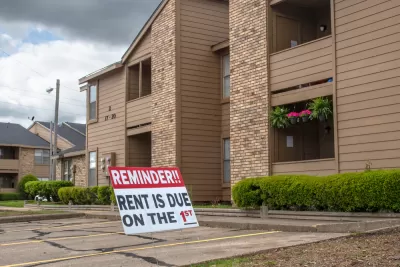
As noted in an article by Whitney Airgood-Obrycki and Alexander Hermann, tracking the health of renters and the rental market has been challenging during the pandemic, as available data tends to certains types of rental buildings. Data from the National Multifamily Housing Coalition, for instance, skews toward buildings with at least five units. The work of Airgood-Obrycki and Hermann aims to fill some of that gap for a better understanding of the risks facing renters in smaller buildings.
The resulting analysis reports dire risks. "Renters living in single-family homes and smaller multifamily buildings, along with the owners of those properties, are more likely to be negatively affected by the COVID-19 economic downturn," according to Airgood-Obrycki and Hermann.
More specifically, "Over half of renters with at-risk wages due to the pandemic live in single-family and small multifamily rentals with 2–4 units," write Airgood-Obrycki and Hermann, who further estimate that "nearly 20 percent of renters in small multifamily apartments may have difficulty paying full rent if at-risk wages are lost, compared to 12 percent of renters living in larger apartments."
The analysis by Airgood-Obrycki and Hermann reveals a disparity in the common understanding of the effects of the coronavirus, which has tended to concentrate on the perceived public health risks of large residential buildings, like in this article by Liam Dillon for the Los Angeles Times, about the pandemic experience in Park Le Brea, the largest apartment complex in California.
FULL STORY: COVID-19 RENT SHORTFALLS IN SMALL BUILDINGS


Mapping Eviction Risk
Millions of renters are at risk of eviction as federal support runs out and the economic realities of the pandemic take hold.

A New, Renter-Friendly Politics Emerges
There are signs that politicians at every level are responding to the concerns of renters like never before. If only renter-friendly housing policies were matters of simple consensus.
Oklahoma has Over 200,000 Vacant Homes. None are Affordable to Low-income Families.
The state faces a shortage of over 80,000 rental units for extremely low-income households while hundreds of thousands of vacant units face financial or legal barriers to restoration.

Planetizen Federal Action Tracker
A weekly monitor of how Trump’s orders and actions are impacting planners and planning in America.

The state-sanctioned urbicide of Austin
People don’t kill cities. Freeways do.

US to reduce Colorado River water deliveries to Mexico
A new Colorado Treaty amendment reduces Mexico’s Colorado River water allocation by 250,000 acre feet.

5 New England states march closer to 800 megawatt wind energy project
Securing federal approval for the project may be complicated under the Trump administration, which has historically been hostile towards domestic wind power.

Baltimore to break ground on $50 million Transit Priority Project
The project will bring faster bus trips, safer streets and better bike connections to Baltimore.

Airbnb launches $250 million 'last-dollar financing' housing accelerator, makes first investment in Austin
The company will put $6.4 million towards affordable housing development in Texas’ capital.

FREE Course: Walkable City 1: Why Walkability?
After describing his path towards focusing on walkability as the essence of good planning, Jeff Speck marches through his five principal reasons for making more walkable places.
Reinventing Malls: Planning Alchemy—Turning Gray Fields Into Gold
The course focuses on the opportunities and imperatives that shape reinvention of mall sites.

Eagle County Government
Harvard University Graduate School of Design
Nashville Planning Department
The Architects Foundation
University of Cincinnati Online
The Pocatello Development Authority
The Urban Renewal Agency of the City of Pocatello
Journal of the American Planning Association