An executive order ramps up the effort to lower emissions in the state, much of which come from transportation.


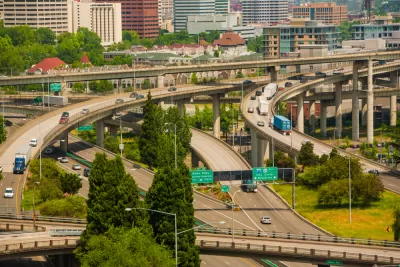
Earlier this month, Governor Kate Brown of Oregon signed Executive Order 20-04, directing state agencies and commissions to take steps to reduce and regulate greenhouse gas emissions. The order also mandates that state agencies work to reduce emissions to 45 percent below 1990 levels by 2035 and to 80 percent below 1990 levels by 2050.
About 40 percent of greenhouse gas emissions in Oregon are related to transportation, writes Jonathan Maus. "[This] action by Governor Brown says [the Oregon Department of Transportation] and [the Oregon Transportation Commission] have a legal requirement to reduce those emissions."
ODOT and OTC must also make implementation of the Oregon Statewide Transportation Strategy a priority. "Furthermore, the order directs ODOT to set metrics and then evaluate GHG impacts of all transportation projects in regional transportation plans," says Maus.
FULL STORY: Governor Brown’s executive order on climate change could have impacts on transportation

Road Pricing: Highway Tolling Suffers Huge Setback
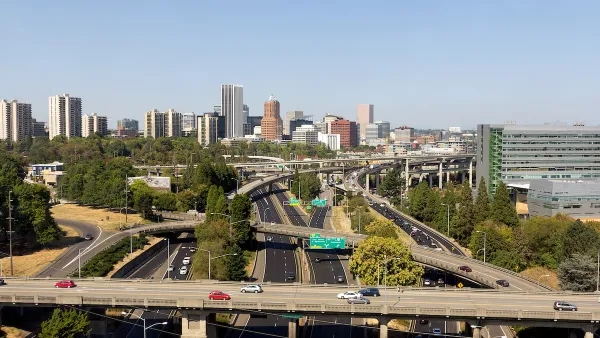
One of the nation's most prominent projects that would have tolled all lanes on two urban interstate highways may have come to an abrupt end on March 11 after Oregon Gov. Tina Kotek pulled her support for the controversial Portland area projects.
Interstate Highway Tolling Takes Major Step Forward in Pacific Northwest
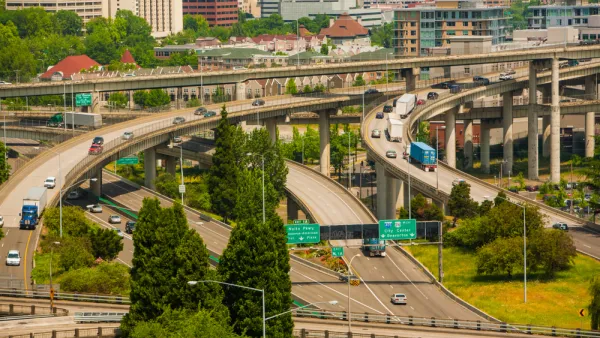
The state that implemented the first gas tax and the first bike tax took a huge step on Thursday toward becoming the first, since 1956, to toll all lanes on an interstate highway by approving an application to the Federal Highway Administration.
Portland's Regional Congestion Pricing Program Widens and Advances
It might be the nation's most significant but least known congestion pricing plan. The plan originally recommended tolling all lanes on segments of two interstates. Four more roads were just added to broaden the plan.

Planetizen Federal Action Tracker
A weekly monitor of how Trump’s orders and actions are impacting planners and planning in America.

The state-sanctioned urbicide of Austin
People don’t kill cities. Freeways do.

US to reduce Colorado River water deliveries to Mexico
A new Colorado Treaty amendment reduces Mexico’s Colorado River water allocation by 250,000 acre feet.

Mamdani overhauls NYC's Vision Zero plan with 100 new policy goals
The overhaul aims to reduce traffic deaths and make streets safer for pedestrians, cyclists and drivers through lower speed limits, new safety infrastructure and more.

Amtrak not solely to blame for New Jersey commuter rail's unreliability, report finds
A new study from the Garden State Initiative found that NJ Transit’s budget grew 20% across a 4 year period, but reliability declined significantly over the same period.

EPA erases limits on planet-warming pollution from power plants
Under Monday’s plan, power plants would still have some limits on how much mercury, arsenic and other contaminants they can emit.

FREE Course: Walkable City 1: Why Walkability?
After describing his path towards focusing on walkability as the essence of good planning, Jeff Speck marches through his five principal reasons for making more walkable places.
Reinventing Malls: Planning Alchemy—Turning Gray Fields Into Gold
The course focuses on the opportunities and imperatives that shape reinvention of mall sites.

Eagle County Government
Harvard University Graduate School of Design
Nashville Planning Department
The Architects Foundation
University of Cincinnati Online
The Pocatello Development Authority
The Urban Renewal Agency of the City of Pocatello
Journal of the American Planning Association