The inventor of the term missing middle housing has advice on writing zoning codes that effectively deliver on the potential of the tool.


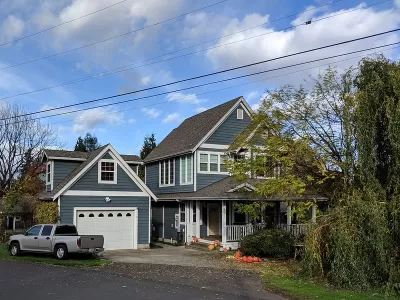
According to a February article by Dan Parolek, recent legislative efforts to legalize missing middle housing (e.g., the Minneapolis 2040 Comprehensive Plan and Oregon’s HB 2001) illustrate how “Missing Middle Housing can go a long way toward meeting housing needs in a variety of places.”
Parolek, credited with coining the term missing middle housing, writes here to offer a few tips to ensure that zoning changes designed to make new space fo missing middle housing will achieve the desired goals of increasing the number of housing units, addressing the high cost of housing, and not letting that new density also mean huge new buildings.
Parolek lists six tips in total, listed here, but also with a lot more detail in the source article.
- Regulate maximum building envelope/form & scale rather than number of units/density
- Carefully regulate building width and depth
- Be careful about allowed height
- Do not allow townhouses or single-family detached homes in which the ground floor is mostly parking
- Some single-family contexts are better than others for Missing Middle Housing
- Communication and framing tips
FULL STORY: Best practices for ending exclusive single-family zoning


Missing Middle Density Will Take More Than Zoning Changes
Looking for change in the housing supply? "Don't stop at the zoning code and think you're done. There's so much work left to do."

Zoning Reforms Underwhelm in Minneapolis as Development Market Holds Course
As one of the first city's to comprehensively allow for residential density, Minneapolis was probably hoping for more than what it's achieved so far.

'Making Room Housing Program' Would Allow New Density in Vancouver
Duplexes, rowhouses, and small apartment buildings will be on the zoning menu for "housing choice neighborhoods" around Vancouver, thanks to the city's new "Making Room Housing Program."

Planetizen Federal Action Tracker
A weekly monitor of how Trump’s orders and actions are impacting planners and planning in America.

The state-sanctioned urbicide of Austin
People don’t kill cities. Freeways do.

US to reduce Colorado River water deliveries to Mexico
A new Colorado Treaty amendment reduces Mexico’s Colorado River water allocation by 250,000 acre feet.

5 New England states march closer to 800 megawatt wind energy project
Securing federal approval for the project may be complicated under the Trump administration, which has historically been hostile towards domestic wind power.

Baltimore to break ground on $50 million Transit Priority Project
The project will bring faster bus trips, safer streets and better bike connections to Baltimore.

Airbnb launches $250 million 'last-dollar financing' housing accelerator, makes first investment in Austin
The company will put $6.4 million towards affordable housing development in Texas’ capital.

FREE Course: Walkable City 1: Why Walkability?
After describing his path towards focusing on walkability as the essence of good planning, Jeff Speck marches through his five principal reasons for making more walkable places.
Reinventing Malls: Planning Alchemy—Turning Gray Fields Into Gold
The course focuses on the opportunities and imperatives that shape reinvention of mall sites.

Eagle County Government
Harvard University Graduate School of Design
Nashville Planning Department
The Architects Foundation
University of Cincinnati Online
The Pocatello Development Authority
The Urban Renewal Agency of the City of Pocatello
Journal of the American Planning Association