The Trump administration prefers the Neoclassical style of buildings like the Treasury Building in Washington, D.C.


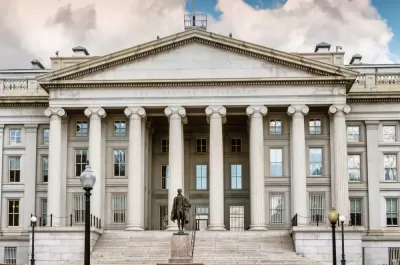
"While the country was riveted by the President’s impeachment trial, a Washington rumor was quietly bubbling about a potential executive order that, if implemented, would profoundly affect the future of federal architecture," reports Cathleen McGuigan.
But rumor gives way to substance, as McGuigan further reports that Architectural Record has obtained "what appears to be a preliminary draft of the order," which would, " require rewriting the Guiding Principles for Federal Architecture, issued in 1962, to ensure that 'the classical architectural style shall be the preferred and default style' for new and upgraded federal buildings," according to McGuigan.
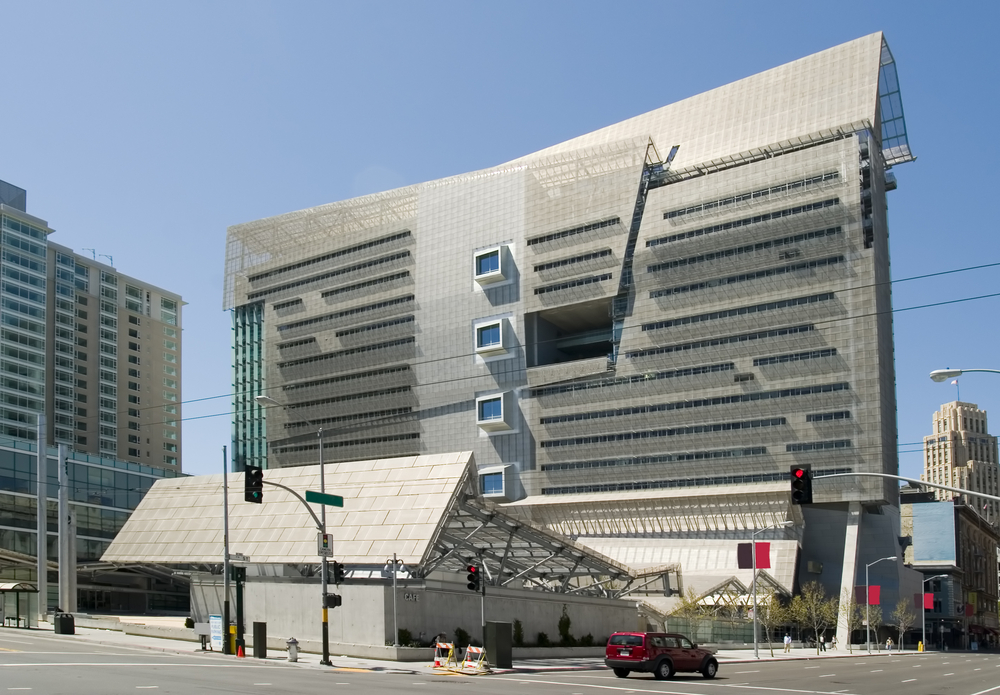
The draft executive order rebuts the kinds of designs put forward under the General Service Administration’s (GSA) Design Excellence Program, according to McGuigan. "The draft document specifically cites the U.S. Federal Building in San Francisco (2007, by Morphosis), the U.S. Courthouse in Austin, Texas (2012, by Mack Scogin Merrill Elam Architects), and the Wilkie D. Ferguson, Jr. U.S. Courthouse in Miami (2007, by Arquitectonica) for having 'little aesthetic appeal.'"
Critics were quick to pounce on the report on Twitter. New York Times Architecture Critic Michael Kimmelman produced this scathing assessment of the idea of forcing the GSA to only build in classical style, for example:
If true it is yet another sign of a nation in retreat from ideas, at war with diversity, with culture, with the true richness of contemporary society, and with itself. https://t.co/PQ4GEZWCG0
— Michael Kimmelman (@kimmelman) February 4, 2020
Other architecture critics from around the country produced similarly scathing assessments of the idea.
a truly appalling development, and oddly a repudiation of trump's own glitzified modern aesthetic. https://t.co/gn8PNPB5BL
— mark lamster (@marklamster) February 4, 2020
Scoop from @ArchRecord . The early Soviets and Nazis were big on creating enormous classically-inspired buildings, too. https://t.co/4IsOruBgCS
— Inga Saffron (@IngaSaffron) February 4, 2020
Read the full story: Will the White House Order New Federal Architecture To Be Classical?

Will the GSA Scandal Harm Design Professionals?
After being rocked by a scandal over extravagant spending, Tom Stoelker wonders whether the General Services Administration (GSA) and their hallmark initiatives, such as the Design Excellence Program, will suffer in the political fallout.
White House Ballroom Details Revealed Ahead of January 15 Legal Hearing
The ballroom project must receive approval from the National Capital Planning Commission to move forward.
Legislation Introduced to Support Adaptive Reuse of Federal Buildings
The proposed bill would promote the conversion of vacant and underused buildings into affordable housing.

Amtrak, CN end decades-long dispute with eight-year agreement
The new operating agreement establishes an updated framework for the companies to work together, including processes to resolve disputes.

Judges permit Denver to divert 77,000 acre feet from the Colorado River for reservoir expansion
Overuse and climate change have caused the Colorado River’s water levels to plummet.

Nation's most wind-powered state turns to coal as data centers increase energy demand
For the first time in decades, Iowa has increased its generation of coal power.

Boston has spent millions making the Green Line more accessible — and there’s no end in sight
While the city has invested millions into expanding and adding platforms to the Green Line to make it more accessible, new train cars set to arrive next year will be too tall for disabled passengers to board without raising the current platforms.

Idaho may see an 18% drop in federal surface transit funding — the largest estimated cut in the US
Transit systems in rural communities are much more reliant on federal funding to provide their services.

How ‘post-disaster gentrification’ alters neighborhoods after natural calamities
After hurricanes, fires or other calamities, the original residents of a community are often replaced by younger, wealthier residents.

FREE Course: Walkable City 1: Why Walkability?
After describing his path towards focusing on walkability as the essence of good planning, Jeff Speck marches through his five principal reasons for making more walkable places.
Reinventing Malls: Planning Alchemy—Turning Gray Fields Into Gold
The course focuses on the opportunities and imperatives that shape reinvention of mall sites.

City of Wisconsin Rapids
Harvard University Graduate School of Design
KFH Group Inc.
The Architects Foundation
University of Cincinnati Online
The Pocatello Development Authority
The Urban Renewal Agency of the City of Pocatello