Despite appearances and a popular media narrative, Baby Boomers aren't becoming more urban in old age—when compared to previous generations at the same age.


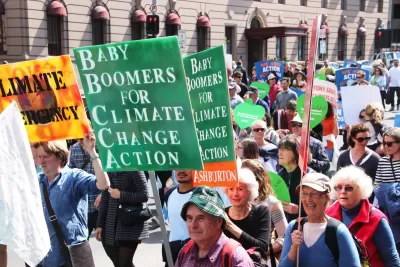
The narrative about Baby Boomers moving back to the city alongside Millennials is wrong, according to an article by Jed Kolko: "Boomers today are actually less urban than previous generations of older people."
If it seems like more baby Boomers are living in the urban cores of metropolitan areas these days, it has more to do with the size of the generation, not the share of the generation.
"In 2018, 17.8 percent of people aged 54 to 72 lived in urban neighborhoods, defined based on neighborhood density," according to Kolko. "That’s down from 18.2 percent for that age group in 2010, 19.9 percent in 2000, and 21.6 percent in 1990."
Kolko has a few other surprises to share, like the declining share of Generation X (declined by 2 percent compared to the same age group living in 2000) and Millennials (declined by 4 percent).
"Moreover, while there has been a notable increase in urban living among higher-income young adults, rich older people are less likely to live in urban neighborhoods in 2018 than their counterparts in 2000, even with a very slight increase since 2012," according to Kolko.
While Baby Boomers aren't flocking back to cities, they are more likely to rent and more likely to live in multi-family developments—urban lifestyles in suburban settings.
FULL STORY: The Myth of the Urban Boomer


Downsizing Baby Boomers May Ease the Housing Crisis
Some hope that a ‘silver tsunami’ of downsizing baby boomers will bring down housing costs, but the reality is likely much more complicated.

Study: Boomers Leaving Their Homes Will Dramatically Increase Housing Supply
New analysis by Zillow predicts a "Silver Tsunami" of residential properties coming to the market as Baby Boomers leave the housing market. The effect could be like the housing boom of the mid-2000s.

Nevertheless, the Youthful Preference for Urban Living Persisted
A forthcoming study, to be published by the Journal of Regional Science, finds the urban preferences of younger generations growing over the past three decades.

Planetizen Federal Action Tracker
A weekly monitor of how Trump’s orders and actions are impacting planners and planning in America.

The state-sanctioned urbicide of Austin
People don’t kill cities. Freeways do.

US to reduce Colorado River water deliveries to Mexico
A new Colorado Treaty amendment reduces Mexico’s Colorado River water allocation by 250,000 acre feet.

5 New England states march closer to 800 megawatt wind energy project
Securing federal approval for the project may be complicated under the Trump administration, which has historically been hostile towards domestic wind power.

Baltimore to break ground on $50 million Transit Priority Project
The project will bring faster bus trips, safer streets and better bike connections to Baltimore.

Airbnb launches $250 million 'last-dollar financing' housing accelerator, makes first investment in Austin
The company will put $6.4 million towards affordable housing development in Texas’ capital.

FREE Course: Walkable City 1: Why Walkability?
After describing his path towards focusing on walkability as the essence of good planning, Jeff Speck marches through his five principal reasons for making more walkable places.
Reinventing Malls: Planning Alchemy—Turning Gray Fields Into Gold
The course focuses on the opportunities and imperatives that shape reinvention of mall sites.

Eagle County Government
Harvard University Graduate School of Design
Nashville Planning Department
The Architects Foundation
University of Cincinnati Online
The Pocatello Development Authority
The Urban Renewal Agency of the City of Pocatello
Journal of the American Planning Association