The story of how the autonomous delivery company Nuro has taken to the streets of Houston to map the city and test its concept.


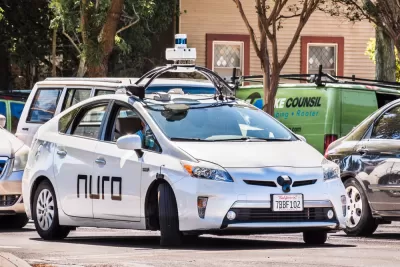
Peter Holley reports on the operations of Nuro, a Silicon Valley-based company operating in Houston in a race to corner the market on autonomous delivery services.
The company aims to become "the world’s preeminent autonomous delivery service, allowing millions of people to have groceries and other goods delivered by robots instead of making trips to the store, potentially reducing traffic and kicking off a new chapter in our relationship with machines," according to Holley.
"For months now, Nuro’s robotically piloted vehicles have been successfully, if quietly, delivering groceries to restaurants and homes around Houston, the vehicles’ sensors mapping the city as they go."
The article presents the current stage of autonomous vehicle technology as a race—one that both could benefit and threaten the safety of the public.
FULL STORY: The future of autonomous delivery may be unfolding in an unlikely place: Suburban Houston

Walmart to Launch Autonomous Grocery Delivery Program in Houston
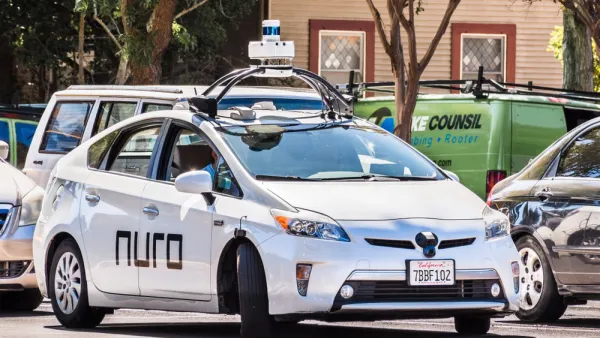
Walmart is planning on delivering groceries autonomously in Houston at some point in 2020.
Opinion: Delivery Robots Need Regulation Now
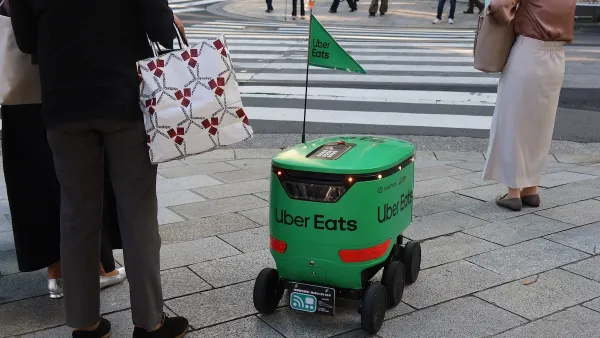
Ride-hailing and scooter companies blindsided cities. They shouldn’t let delivery robots do the same.
Ups and Downs for Self-Driving Cars During the Pandemic
While some driverless car companies have expanded operations in the past month, some industry observers caution that the business of autonomous vehicles remains stuck in neutral.

Planetizen Federal Action Tracker
A weekly monitor of how Trump’s orders and actions are impacting planners and planning in America.

The state-sanctioned urbicide of Austin
People don’t kill cities. Freeways do.

US to reduce Colorado River water deliveries to Mexico
A new Colorado Treaty amendment reduces Mexico’s Colorado River water allocation by 250,000 acre feet.

Mamdani overhauls NYC's Vision Zero plan with 100 new policy goals
The overhaul aims to reduce traffic deaths and make streets safer for pedestrians, cyclists and drivers through lower speed limits, new safety infrastructure and more.

Amtrak not solely to blame for New Jersey commuter rail's unreliability, report finds
A new study from the Garden State Initiative found that NJ Transit’s budget grew 20% across a 4 year period, but reliability declined significantly over the same period.

EPA erases limits on planet-warming pollution from power plants
Under Monday’s plan, power plants would still have some limits on how much mercury, arsenic and other contaminants they can emit.

FREE Course: Walkable City 1: Why Walkability?
After describing his path towards focusing on walkability as the essence of good planning, Jeff Speck marches through his five principal reasons for making more walkable places.
Reinventing Malls: Planning Alchemy—Turning Gray Fields Into Gold
The course focuses on the opportunities and imperatives that shape reinvention of mall sites.

Eagle County Government
Harvard University Graduate School of Design
Nashville Planning Department
The Architects Foundation
University of Cincinnati Online
The Pocatello Development Authority
The Urban Renewal Agency of the City of Pocatello
Journal of the American Planning Association