Cities are built by men, and so too often urban design does not reflect the needs, perspectives, and realities of women.


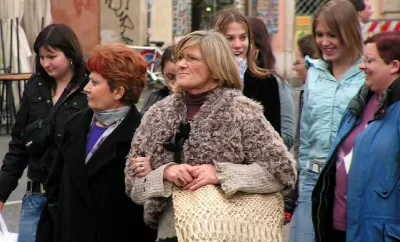
"Cities are supposed to be built for all of us, but they aren't built by all of us," says Stephanie Hegarty in a BBC video report. She talks to members of Col·lectiu Punt 6, a feminist collective of urban designers in Barcelona, about how cities can better serve women and the innovative projects happening in the city.
For example, women use public restrooms more often and for longer periods of time than men, and they often need to bring in strollers. And men can stand while women need stalls, meaning that women’s restroom spaces should be larger. Hegarty also looks at how public spaces, like playgrounds, are segregated and ways design can better integrate these places.
Punt 6 and Janet Sanz, Barcelona’s Deputy Mayor for Urbanism, also advocate for more accessible transportation spaces and less car-centric urban design. Barcelona has developed a series of innovative superblocks, areas where nine smaller blocks are combined to create a larger network of streets that support biking, pedestrians, and public spaces and where car use is limited. Women in Barcelona have also expressed an overwhelming desire for more benches, and the city has installed hundreds of them in neighborhoods, along with trees and more greenspace.
Barcelona is also known as a party town where women do not always feel comfortable and safe. "Now the city is saying no to sleaze with these anti-machismo stands," notes Hegarty. Women can go to the stands to get more information about resources and a new app that the city has put out to report incidents of sexual harassment or violence.
"Seeing what a city built by women would look like is still just a fantasy. But these women are giving a glimpse of what that future could be," concludes Hegarty.
FULL STORY: What would a city designed by women be like?


Barcelona's Long-Term, Pedestrian-First Plan Continues with the 'Barcelona Superblock'
Mayor Ada Colau announced the next step in Barcelona's plan to convert the city center into a "new city for the present and the future."
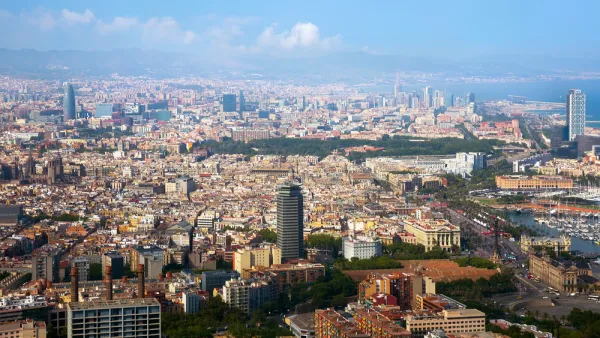
Barcelona's Ambitious Plan to Become a Post-Car City
Barcelona is planning to expand on its initial superblock experiment in an attempt to ease the stranglehold of car congestion and air pollution gripping the dense city.
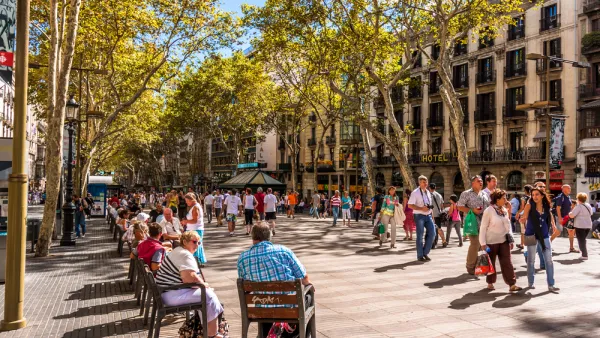
Barcelona 'Superblocks' Aim to Cut Down on Cars
Seeking relief from noise, pollution, and incessant traffic, the city of Barcelona has a bold plan to repurpose street space. "Superblocks" will route cars around the perimeter, leaving interior streets open for walkers and bikes.

The state-sanctioned urbicide of Austin
People don’t kill cities. Freeways do.

US to reduce Colorado River water deliveries to Mexico
A new Colorado Treaty amendment reduces Mexico’s Colorado River water allocation by 250,000 acre feet.

New Jersey’s second-largest city bans standalone data centers
Jersey City will continue to allow co-location facilities, such as those meant for research institutions that store their own data.

Amtrak not solely to blame for New Jersey commuter rail's unreliability, report finds
A new study from the Garden State Initiative found that NJ Transit’s budget grew 20% across a 4 year period, but reliability declined significantly over the same period.

EPA erases limits on planet-warming pollution from power plants
Under Monday’s plan, power plants would still have some limits on how much mercury, arsenic and other contaminants they can emit.

Phoenix announces new on-demand transit service, more frequent RAPID buses
Both new services will launch in October, and are part of Phoenix's Project Effective Access Solutions for Easing Congestion.

FREE Course: Walkable City 1: Why Walkability?
After describing his path towards focusing on walkability as the essence of good planning, Jeff Speck marches through his five principal reasons for making more walkable places.
Reinventing Malls: Planning Alchemy—Turning Gray Fields Into Gold
The course focuses on the opportunities and imperatives that shape reinvention of mall sites.

Eagle County Government
Harvard University Graduate School of Design
Nashville Planning Department
The Architects Foundation
University of Cincinnati Online
The Pocatello Development Authority
The Urban Renewal Agency of the City of Pocatello
Journal of the American Planning Association