The Georgia Department of Transportation and the Federal Railroad Administration recently released a draft study of a plan to link Atlanta and Charlotte via high-speed rail.


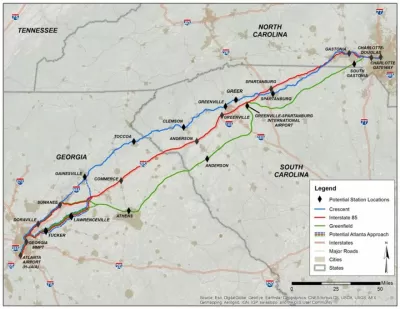
David Wickert reports: "High-speed rail could whisk passengers between Atlanta and Charlotte, N.C., in a little over two hours, but it would cost billions of dollars to build, a new study shows."
The project is estimated to cost $15.4 billion according to a draft environmental impact statement (DEIS) released by the Georgia Department of Transportation and the Federal Railroad Administration. The DEIS does not identify funding or a timetable, but the release does launch a public comment period.
The DEIS considers three possible routes for the line: the "Southern Crescent" route that would follow Norfolk Southern railroad right of way, the I-85 corridor that follows the interstate, and the "Greenfield" corridor located south of I-85.
"Cost estimates, travel times and projected ridership vary substantially, with the Greenfield corridor offering the fastest travel times and the highest passenger volumes," explains Wickert of the findings of the report's analysis. The I-85 route would be most expensive, and the Southern Crescent route is by far the cheapest option.
FULL STORY: Atlanta to Charlotte in 2 hours 6 minutes?

Six-Story Parking Lot Nixed From D.C. Union Station Renovation Plans
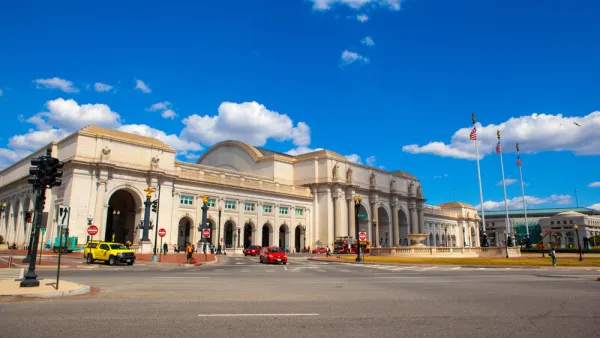
The Federal Railroad Administration has removed a six-story parking facility included in a 2020 draft Environmental Impact Statement for a $10 billion renovation of Union Station in Washington, D.C.
Increasing the Ambition for an Atlanta-Area Express Bus Lane Project
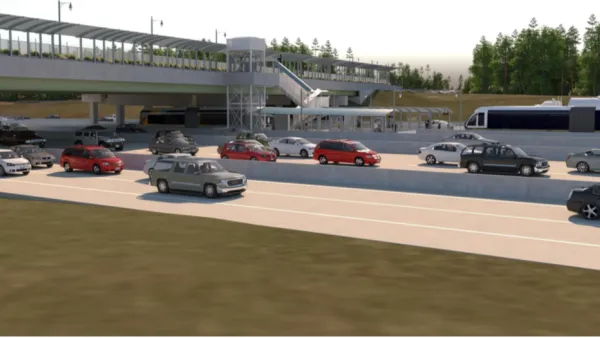
The Metropolitan Atlanta Rapid Transit Authority recently proposed ambitious station design concepts to supplement the Georgia Department of Transportation's plans for a 16-mile express bus lane system on Ga. Highway 400.
Union Station Redesign Gets a Placemaking Do Over
Criticisms of a draft plan to revamp D.C.'s Union Station have described the proposal as far too concerned with car storage.

The state-sanctioned urbicide of Austin
People don’t kill cities. Freeways do.

US to reduce Colorado River water deliveries to Mexico
A new Colorado Treaty amendment reduces Mexico’s Colorado River water allocation by 250,000 acre feet.

New Jersey’s second-largest city bans standalone data centers
Jersey City will continue to allow co-location facilities, such as those meant for research institutions that store their own data.

Amtrak not solely to blame for New Jersey commuter rail's unreliability, report finds
A new study from the Garden State Initiative found that NJ Transit’s budget grew 20% across a 4 year period, but reliability declined significantly over the same period.

EPA erases limits on planet-warming pollution from power plants
Under Monday’s plan, power plants would still have some limits on how much mercury, arsenic and other contaminants they can emit.

Phoenix announces new on-demand transit service, more frequent RAPID buses
Both new services will launch in October, and are part of Phoenix's Project Effective Access Solutions for Easing Congestion.

FREE Course: Walkable City 1: Why Walkability?
After describing his path towards focusing on walkability as the essence of good planning, Jeff Speck marches through his five principal reasons for making more walkable places.
Reinventing Malls: Planning Alchemy—Turning Gray Fields Into Gold
The course focuses on the opportunities and imperatives that shape reinvention of mall sites.

Eagle County Government
Harvard University Graduate School of Design
Nashville Planning Department
The Architects Foundation
University of Cincinnati Online
The Pocatello Development Authority
The Urban Renewal Agency of the City of Pocatello
Journal of the American Planning Association