A law approved by the Denver City Council this week makes it much easier to build tiny homes in Denver.


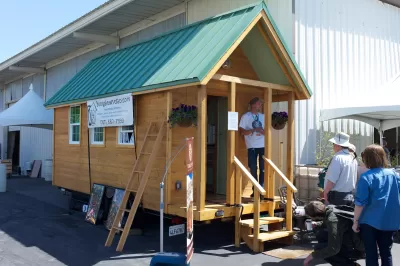
"The Denver City Council voted on Monday to make it easier to build tiny-home communities in most of Denver," reports Andrew Kenney.
"The new city law allows tiny home villages to be built across industrial, commercial and mixed-use sites, along with certain sites in residential neighborhoods. Villages could appear on future development sites, spare city land, or even church properties," according to Kenney.
The city's first sanctioned tiny home village, Beloved Community Village, set the context of the new law. The village opened in 2016, has raised hundreds of thousands of dollars, but has been unable to expand or to duplicate its successes elsewhere in the city. The new law would make it easier to build similar villages.
Much of Kenney's focus in the wake of the City Council's action to approve permissive regulations for tiny homes is the possibility that the new law could pave the way looser regulations on mobile homes. Eventually, Kenney also ties the approval of new regulations for tiny homes to the city's recent approval of Blueprint Denver and the Comprehensive Plan 2040, which guide housing production until the year 2040.
Read the full story: Denver opens the door for tiny homes. Will mobile homes be next?


Tiny House Villages for Addressing Homelessness: An Interview with Yetimoni Kpeebi
One researcher's perspective on the potential of tiny homes and owner-built housing as one tool to fight the housing crisis.

California’s Tiny Home Pledge Still on Paper, One Year Later
A promise to fund 1,200 tiny homes for unhoused residents in four cities as a way to rapidly and cost-effectively provide shelter has yet to yield tangible results, but projects are moving ahead in some cities.

Tiny Homes are a First—but not Last—Step in Ending Homelessness
Cities are trying to stretch affordable housing funds to meet the demand for both short- and long-term housing.

Planetizen Federal Action Tracker
A weekly monitor of how Trump’s orders and actions are impacting planners and planning in America.

‘Going backwards:’ Baltimore mayor, students rally against state's transit funding plan
Maryland's proposed six-year plan provides no funding for Baltimore’s BMORE bus program and reduces its road maintenance funding.
Mamdani sent nearly 6,000 pied-à-terre tax warnings to homes that didn’t qualify
A judge has ordered the administration to cancel thousands of pied-à-terre tax notices after it sent 35% of them erroneously.

Mamdani sent nearly 6,000 pied-à-terre tax warnings to homes that didn’t qualify
A judge has ordered the administration to cancel thousands of pied-à-terre tax notices after it sent 35% of them erroneously.

Detroit to transform waterfront with $2.2 billion investment
Developers will convert about 18 acres of unused parking lot space into civic spaces.

‘Going backwards:’ Baltimore mayor, students rally against state's transit funding plan
Maryland's proposed six-year plan provides no funding for Baltimore’s BMORE bus program and reduces its road maintenance funding.

FREE Course: Walkable City 1: Why Walkability?
After describing his path towards focusing on walkability as the essence of good planning, Jeff Speck marches through his five principal reasons for making more walkable places.
Reinventing Malls: Planning Alchemy—Turning Gray Fields Into Gold
The course focuses on the opportunities and imperatives that shape reinvention of mall sites.

City of Thousand Oaks
City of Wisconsin Rapids
Harvard University Graduate School of Design
The Architects Foundation
University of Cincinnati Online
Northern Illinois Transit Authority (NITA)
The Pocatello Development Authority
The Urban Renewal Agency of the City of Pocatello