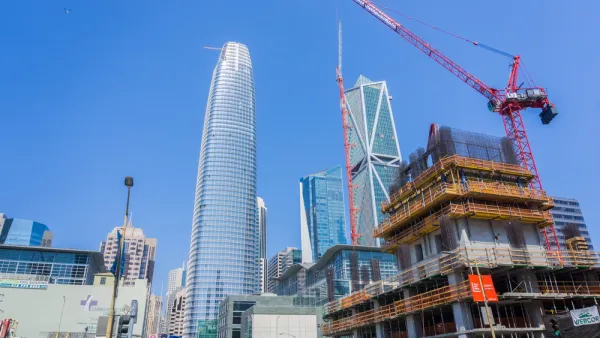
A luxury residential high rise, conspicuously located near the Bay Bridge in a quickly growing section of the city, could finally have a plan to fix its sagging foundation.


J.K. Dineen reports: "Independent experts charged with reviewing the proposed $100 million fix to San Francisco’s famously sinking and tilting Millennium Tower endorsed the plan Tuesday, saying that they 'see no reason to withhold approval of the building permit for the structural upgrade of the foundation.'"
The work would require "52 piles to be drilled 250 feet down into bedrock to shore up the building," according to Dineen. "The 2-foot-thick circular steel piles would be filled with steel reinforced concrete."
"The 52 new piles will extend into bedrock beneath the soils and will be structurally connected to the existing foundation by an extension of the building’s concrete mat," adds Dineen.
The work is necessary because the building is leaning 17 inches to the north and west. The building isn't the only structure in the quickly expanding neighborhood to encounter high-profile construction woes. The nearby Transbay Terminal was shut down for most of the year after cracks were discovered in structural beams a few months after opening.
FULL STORY: Expert panel endorses plan to stabilize SF’s leaning Millennium Tower

San Francisco Considers More Aggressive Measures to Earthquake-Proof High Rises
The city has proposed tighter rules for new construction and a more active approach to securing existing tall structures from collapse.
One of San Francisco's Toniest High Rises Has a Sinking Feeling
Home to some of the city's most famous athletes and industry chiefs, the Millennium Tower could soon be home to a protracted and expensive legal battle.

As prices skyrocket, San Francisco Mayor declares rent emergency
Landlords in San Francisco have initiated over 2,400 evictions since January, putting the city on track to see more evictions this year than during any year in the past decade.

Planetizen Federal Action Tracker
A weekly monitor of how Trump’s orders and actions are impacting planners and planning in America.

The state-sanctioned urbicide of Austin
People don’t kill cities. Freeways do.

US to reduce Colorado River water deliveries to Mexico
A new Colorado Treaty amendment reduces Mexico’s Colorado River water allocation by 250,000 acre feet.

Mamdani overhauls NYC's Vision Zero plan with 100 new policy goals
The overhaul aims to reduce traffic deaths and make streets safer for pedestrians, cyclists and drivers through lower speed limits, new safety infrastructure and more.

Amtrak not solely to blame for New Jersey commuter rail's unreliability, report finds
A new study from the Garden State Initiative found that NJ Transit’s budget grew 20% across a 4 year period, but reliability declined significantly over the same period.

EPA erases limits on planet-warming pollution from power plants
Under Monday’s plan, power plants would still have some limits on how much mercury, arsenic and other contaminants they can emit.

FREE Course: Walkable City 1: Why Walkability?
After describing his path towards focusing on walkability as the essence of good planning, Jeff Speck marches through his five principal reasons for making more walkable places.
Reinventing Malls: Planning Alchemy—Turning Gray Fields Into Gold
The course focuses on the opportunities and imperatives that shape reinvention of mall sites.

_construction_site,_with_the_Transbay_Terminal_behind,_SF.JPG)
Eagle County Government
Harvard University Graduate School of Design
Nashville Planning Department
The Architects Foundation
University of Cincinnati Online
The Pocatello Development Authority
The Urban Renewal Agency of the City of Pocatello
Journal of the American Planning Association