The Overton Window is widening on the subject of congestion pricing.



The National League of Cities (NLC) has published a new report suggesting local governments implement congestions as a tool for easing congestion, improving quality of life, and raising funds for infrastructure maintenance and improvements.
The "Making Space: Congestion Pricing in Cities" [pdf] report, references case studies in London, Stockholm, Singapore and New York, according to an article by Katie Pyzyk.
Perhaps most importantly for the future adoption of congestion pricing, "[t]he guide concludes that congestion pricing might become even more important in cities as electric vehicles (EVs) and and [sic] autonomous vehicles (AVs) grow more prevalent. "
"It also notes that small and medium-sized cities should remain open to the concept, and cities that don't yet struggle with traffic should as well," according to Pyzyk.
As if to further prove the improving potential of congestion pricing, The Oregonian this week published an op-ed supportive of congestion pricing for Portland, as written by Eric Fruits, vice president of research at Cascade Policy Institute and an adjunct economics professor at Portland State University.
FULL STORY: NLC calls on cities to consider congestion pricing

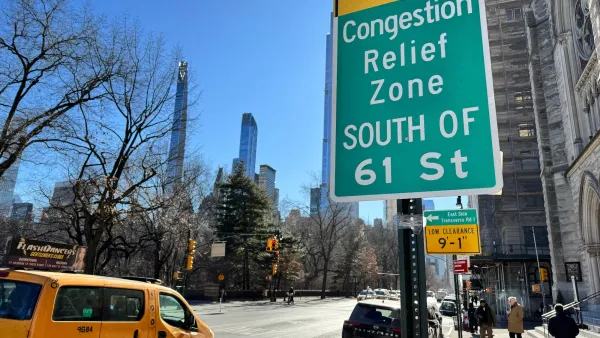
2025’s Biggest Transportation Wins
Even in a rough year, there are victories worth celebrating.
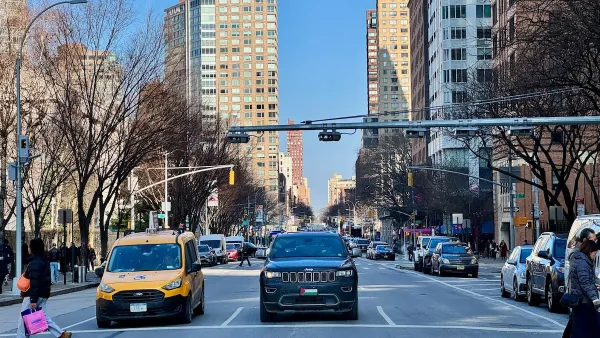
NYC’s ‘Rare and Comprehensive’ Public Data Reveals Congestion Pricing's Success
The Metropolitan Transportation Authority’s analytics and data team maintains over 180 regularly updated datasets about the city’s transportation system.
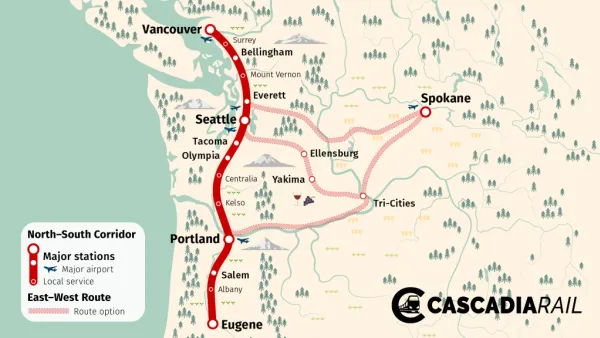
Cascadia High-Speed Rail Corridor Seeking Federal Funding
The state of Washington is hoping federal infrastructure funding can pay for $198 million of the $348 million necessary to plan the Cascadia High-Speed Rail project.

Planetizen Federal Action Tracker
A weekly monitor of how Trump’s orders and actions are impacting planners and planning in America.

The state-sanctioned urbicide of Austin
People don’t kill cities. Freeways do.

US to reduce Colorado River water deliveries to Mexico
A new Colorado Treaty amendment reduces Mexico’s Colorado River water allocation by 250,000 acre feet.

5 New England states march closer to 800 megawatt wind energy project
Securing federal approval for the project may be complicated under the Trump administration, which has historically been hostile towards domestic wind power.

Baltimore to break ground on $50 million Transit Priority Project
The project will bring faster bus trips, safer streets and better bike connections to Baltimore.

Airbnb launches $250 million 'last-dollar financing' housing accelerator, makes first investment in Austin
The company will put $6.4 million towards affordable housing development in Texas’ capital.

FREE Course: Walkable City 1: Why Walkability?
After describing his path towards focusing on walkability as the essence of good planning, Jeff Speck marches through his five principal reasons for making more walkable places.
Reinventing Malls: Planning Alchemy—Turning Gray Fields Into Gold
The course focuses on the opportunities and imperatives that shape reinvention of mall sites.

Eagle County Government
Harvard University Graduate School of Design
Nashville Planning Department
The Architects Foundation
University of Cincinnati Online
The Pocatello Development Authority
The Urban Renewal Agency of the City of Pocatello
Journal of the American Planning Association