Five "climate mayors" addressed the Senate Democrats’ Special Committee on the Climate Crisis at their fist hearing on July 17, titled, “A Blueprint for Success: U.S. Climate Action at the Local Level.” Transportation was a major issue.


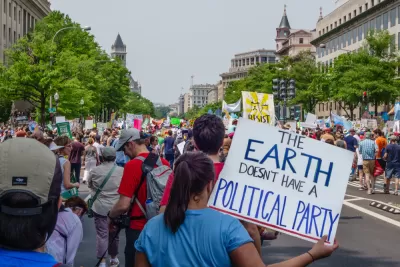
"Five U.S. mayors testified to a new climate committee in the U.S. Senate today that transportation projects are helping their cities hit ambitious emissions targets—but in order to achieve their goals, they need more help from the federal government," reports Alissa Walker, the urbanism editor at Curbed.
The mayors— Honolulu Mayor Kirk Caldwell, Atlanta Mayor Keisha Lance Bottoms, St. Paul, Minnesota Mayor Melvin Carter, Pittsburgh Mayor Bill Peduto, and Portland, Oregon, Mayor Ted Wheeler—are part of a coalition of over 400 “climate mayors” who have set goals for city emission reductions aligned with the Paris climate accord.
Unlike the Climate Mayors group, the committee the five mayors addressed is not bipartisan, as its name indicates.
"The purpose of the Senate Democrats’ Special Committee on the Climate Crisis is to examine how climate change is affecting the country and the planet and to mobilize action and support for bold climate solutions," states its webpage on the Senate Democrats website.
We cannot wait for Republicans in the Senate to accept—let alone propose solutions to fix—climate change in a real way. That is why this Special Committee is an important step on the path to solutions in the U.S. Senate.
Led by Hawaii's Brian Schatz, the ten members of the committee include U.S. Senators Sheldon Whitehouse (D-R.I.), Jeff Merkley (D-Ore.), Michael Bennet (D-Colo.), Tammy Baldwin (D-Wis.), Martin Heinrich (D-N.M.), Ed Markey (D-Mass.), Tammy Duckworth (D-Ill.), Catherine Cortez Masto (D-Nev.), and Tina Smith (D-Minn.).
“What we all know is transportation accounts for 30 percent of all greenhouse gas emissions and is the largest single contributor to the climate change crisis in the United States,” said Sen. Catherine Cortez Masto of Nevada in her address to the group. “Every single one of you, that’s one of your biggest challenges, transportation.”
“We are doing our part on the local level to address our climate crisis, but without significant federal action our efforts will not be enough,” said St. Paul Mayor Melvin Carter.
"Specific asks for federal legislators included raising the country’s gas tax, changing tolling systems on federal highways to allow for congestion pricing schemes, and boosting regional high-speed rail projects," adds Walker.
A video of the one and one-half hour hearing is on the source article and the committee's announcement of the hearing, which includes links to the prepared testimonies of the five guests. Walker includes several notable excerpts.
Pittsburgh Mayor Peduto, who had attended the U.N. Climate Change Conference in Katowice, Poland last December as a representative of the Climate Mayors, explained the climate-urbanism connection in his testimony [pdf].
Cities are central to the cause of addressing the issue of climate change. Seventy percent of emissions are generated in cities. Concurrently, cities face the greatest amount of catastrophic risk associated with weather born events.
Portland Mayor Wheeler spoke about the federal highway tolling restrictions as one of three "asks" in his testimony [pdf] for federal support, which directly relates to an application to the Federal Highway Administration to toll all lanes on stretches of two Portland-area interstates.
Remove tolling restrictions on federally-funded roadways (specifically the statutory language in 23 U.S.C. 129(a)) to create a robust set of tools for state and local jurisdictions to maintain and manage the transportation system.
Tolling can generate revenue for maintenance, while also being used to manage demand to ensure existing facilities are used as efficiently as possible. While some exceptions were created through the MAP-21 authorization bill, the process remains unnecessarily restrictive, given the current federal underinvestment in the transportation system.
A place for Senate Republicans?
The second hearing of the Special Committee on the Climate Crisis was held last Thursday, July 25, titled, "The Right Thing To Do: Conservatives for Climate Action" that featured speakers from Students for Carbon Dividends and Citizens' Climate Lobby, and Frank Luntz, a tenured Republican pollster.
Miranda Green, energy and environment reporter for The Hill, reported on the hearing.
“Today we continue to build the case that climate action is doable and not the exclusive domain of progressives," said Sen. Brian Schatz (D-Hawaii), chairman of the committee.
"But right now Democrats don’t have a dance partners on climate action in the United States Senate. Our Republican colleagues have chosen not to be here.”
Related in Planetizen:
-
August 7, 2018
- Honolulu Mayor Tells All City Departments to Prepare for Sea Level Rise, July 24, 2018
- St. Paul Seeks State Money for Parking Garage, May 29, 2018
-
Atlanta Ordinance Would Require Electric Vehicle Charging Stations in New Buildings, proposed by Councilmember Keisha Lance Bottoms, now mayor.October 22, 2017
Hat tip to CityLab Daily.
FULL STORY: ‘We have to do this together'

Time for a Federal Gas Tax Holiday?
Senate Democrats introduced legislation to lower gas prices by suspending the federal gas tax through the end of the year. General funds would be directed to the Highway Trust Fund to replace gas tax revenue.
Atlanta City Council Adopts Amended Version of the City's New Comprehensive Development Plan
What started out as an ambitious example of planning and zoning reforms has been trimmed back to respond to opposition from neighborhood groups—and the threat of secession from one neighborhood in particular.
Widespread Neighborhood Opposition to Atlanta's Comprehensive Development Plan
A generational comprehensive planning effort hangs in the balance in the city of Atlanta.

The state-sanctioned urbicide of Austin
People don’t kill cities. Freeways do.

US to reduce Colorado River water deliveries to Mexico
A new Colorado Treaty amendment reduces Mexico’s Colorado River water allocation by 250,000 acre feet.

New Jersey’s second-largest city bans standalone data centers
Jersey City will continue to allow co-location facilities, such as those meant for research institutions that store their own data.

Amtrak not solely to blame for New Jersey commuter rail's unreliability, report finds
A new study from the Garden State Initiative found that NJ Transit’s budget grew 20% across a 4 year period, but reliability declined significantly over the same period.

EPA erases limits on planet-warming pollution from power plants
Under Monday’s plan, power plants would still have some limits on how much mercury, arsenic and other contaminants they can emit.

Phoenix announces new on-demand transit service, more frequent RAPID buses
Both new services will launch in October, and are part of Phoenix's Project Effective Access Solutions for Easing Congestion.

FREE Course: Walkable City 1: Why Walkability?
After describing his path towards focusing on walkability as the essence of good planning, Jeff Speck marches through his five principal reasons for making more walkable places.
Reinventing Malls: Planning Alchemy—Turning Gray Fields Into Gold
The course focuses on the opportunities and imperatives that shape reinvention of mall sites.

Eagle County Government
Harvard University Graduate School of Design
Nashville Planning Department
The Architects Foundation
University of Cincinnati Online
The Pocatello Development Authority
The Urban Renewal Agency of the City of Pocatello
Journal of the American Planning Association