A new study finds that interim recreational use of underutilized sections of crowded cities can benefit more than just humans.


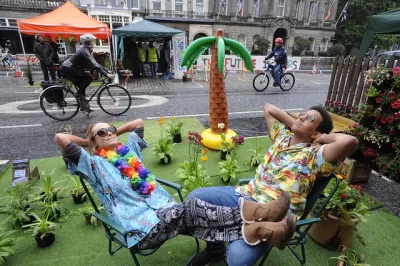
Adina Solomon shares news of research recently published in the Environment International journal that finds evidence of the health, social, and environmental benefits of urban green space, and makes the case for interventions that create new urban green space, even if just temporarily.
Solomon explains:
Sometimes, cities lack large greenspace not only for people but for wildlife — the insects, birds and other animals that make for a balanced ecosystem.
One answer to this issue? Pop-up parks, according to a new study examining their effects on biodiversity.
Luis Mata, ecologist with the People, Nature, Place research program at Royal Melbourne Institute of Technology University’s Centre for Urban Research, and team examined the Grasslands, a six-week park in Melbourne.
"Like many pop-up parks, Grasslands is not what many people envision when they think of greenspace," according to Solomon. But the park showed significant biodiversity in its insect and spider population, which means benefits for pollination and nutrient cycling.
To further exemplify some of the concepts and outcomes under examination by Mata's research, Solomon also cites the example of the Pop-Up Urban Park in Wichita, Kansas.
FULL STORY: Pop-Up Parks Lead to More Biodiversity in Cities, Study Finds

Regenerating and Healing Land Through Parks
Through thoughtful planning and restoration efforts, parks can help heal degraded land, meeting multiple community needs, improving soil quality, restoring native vegetation, and creating habitats for wildlife.
Los Angeles County Parks Department Releases Five-Year Strategic Plan
The L.A. County Department of Parks and Recreation recently completed a strategic plan which details goals, strategies, and actions that reflect the agency's commitment to advancing equity.
Research Shows Urban Trees Stave off Depression
A new study shows that regular exposure to trees and green spaces has a powerful impact on depression and mental health.

Planetizen Federal Action Tracker
A weekly monitor of how Trump’s orders and actions are impacting planners and planning in America.

The state-sanctioned urbicide of Austin
People don’t kill cities. Freeways do.

US to reduce Colorado River water deliveries to Mexico
A new Colorado Treaty amendment reduces Mexico’s Colorado River water allocation by 250,000 acre feet.

5 New England states march closer to 800 megawatt wind energy project
Securing federal approval for the project may be complicated under the Trump administration, which has historically been hostile towards domestic wind power.

Baltimore to break ground on $50 million Transit Priority Project
The project will bring faster bus trips, safer streets and better bike connections to Baltimore.

Airbnb launches $250 million 'last-dollar financing' housing accelerator, makes first investment in Austin
The company will put $6.4 million towards affordable housing development in Texas’ capital.

FREE Course: Walkable City 1: Why Walkability?
After describing his path towards focusing on walkability as the essence of good planning, Jeff Speck marches through his five principal reasons for making more walkable places.
Reinventing Malls: Planning Alchemy—Turning Gray Fields Into Gold
The course focuses on the opportunities and imperatives that shape reinvention of mall sites.

Eagle County Government
Harvard University Graduate School of Design
Nashville Planning Department
The Architects Foundation
University of Cincinnati Online
The Pocatello Development Authority
The Urban Renewal Agency of the City of Pocatello
Journal of the American Planning Association