The lengths to which the city of Cincinnati should go to attract development investments was up for debate this week.


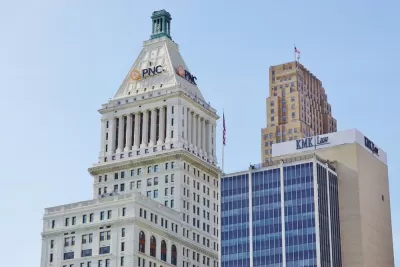
Nick Swartsell reports on a glut of development subsidies approved by the Cincinnati City Council earlier this week, ranging from an adaptive reuse project that will convert an historic office building to a 262-unit apartment building, a mixed-use development on the riverfront, and many more projects.
"But not everyone is happy about every one of those deals," according to Swartsell. "Some activist groups have objected to the foregone taxes and the lack of affordable housing in the projects. Boosters, however, say they represent valuable opportunities to spur new construction and efforts to rehabilitate significant buildings in the city."
As noted by Swartsell, the largest project is the aforementioned proposal to convert the PNC Tower, built in 1913, into 262 apartments at the cost of $103 million.
"The city has offered a forgivable $2.5 million loan — $1.5 million upfront and another million that will be released later, after the developer makes $9 million worth of facade restorations. Instead of property taxes, the developers would pay into a tax increment financing district created around the building. Eventually, the city would return more than $11 million from that TIF to the developer. The city would keep another $7.75 million. The project has also received federal Historic Preservation Tax Credits."
The Cincinnati Federation of Teachers is one of the leading critics of this development deal, among the others approve this week by the Cincinnati Council. Additional coverage of the deals, and the debate, is also available from an article by Chris Wetterich, written before the council action.
FULL STORY: A Bevy of Cincinnati Development Projects Get Tax Incentives


With Zero Office Conversions in Four Years, San Francisco Pins Hopes on New Special Financing District
City leaders hope the new incentive will spur the redevelopment of some of the city’s 30,000 square feet of vacant office space into housing.
Arizona Town Expands Infill Incentive District
The Chandler City Council voted to add the city’s downtown and other areas to an incentive program that supports infill development.

Debating Public Incentives for Private Developments
A debate common in growing cities around the country is taking place in Atlanta in answer to the question of how much support private developers need from the public.

Planetizen Federal Action Tracker
A weekly monitor of how Trump’s orders and actions are impacting planners and planning in America.

The state-sanctioned urbicide of Austin
People don’t kill cities. Freeways do.

US to reduce Colorado River water deliveries to Mexico
A new Colorado Treaty amendment reduces Mexico’s Colorado River water allocation by 250,000 acre feet.

5 New England states march closer to 800 megawatt wind energy project
Securing federal approval for the project may be complicated under the Trump administration, which has historically been hostile towards domestic wind power.

Baltimore to break ground on $50 million Transit Priority Project
The project will bring faster bus trips, safer streets and better bike connections to Baltimore.

Airbnb launches $250 million 'last-dollar financing' housing accelerator, makes first investment in Austin
The company will put $6.4 million towards affordable housing development in Texas’ capital.

FREE Course: Walkable City 1: Why Walkability?
After describing his path towards focusing on walkability as the essence of good planning, Jeff Speck marches through his five principal reasons for making more walkable places.
Reinventing Malls: Planning Alchemy—Turning Gray Fields Into Gold
The course focuses on the opportunities and imperatives that shape reinvention of mall sites.

Eagle County Government
Harvard University Graduate School of Design
Nashville Planning Department
The Architects Foundation
University of Cincinnati Online
The Pocatello Development Authority
The Urban Renewal Agency of the City of Pocatello
Journal of the American Planning Association