Chicago’s alderman have control of millions of dollars of street resurfacing "menu money" for local projects. Inspector General Joe Ferguson argues that money would be better spent in a coordinated effort.



Chicago’s Aldermen, who make up the city council, each have control over their own fund for infrastructure. Some see this as a bad use of resources. "Inspector General Joe Ferguson argued that a 'holistic approach to core infrastructure' would help the city 'realize significant savings for its taxpayers and the infrastructure they depend on,'" Fran Spielman reports for the Sun-Times.
The city has 50 wards, and by breaking the funding into 50 pieces the city erodes its power and is sometimes operates at cross purposes, Ferguson argues. Beyond the lack of coordination, there's also an issue of who gets what funds. "In an audit that sent shock waves through the City Council, Ferguson said the program was under-funded by $122.9 million a year and '…bears no relationship to the actual infrastructure needs' of each ward and includes significant 'funding disparities,'" Spielman reports.
Former Mayor Rahm Emanuel criticized the proposal of abolishing menu money as unrealistic, describing it as something some one might dream up while they "walk around with a glass of white wine."
Read the full story: Ferguson urges Lightfoot to yank residential street resurfacing from $66 million-a-year aldermanic menu program

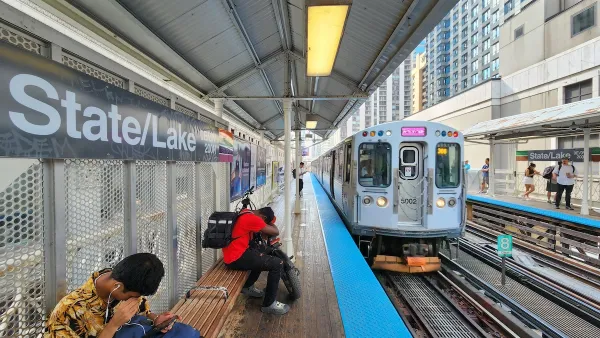
Trump Freezes $2.1 Billion for Chicago Transit and Infrastructure Projects
The administration plans to revoke federal funding over what it calls “discriminatory, illegal, and wasteful contracting practices.”

Elon Musk Company Closes in on Chicago's Airport Express
The announcement of the finalists to build the O'Hare Express has critics even more concerned about the project's viability.

Rahm Emanuel's Chicago Infrastructure Trust Expensive and Redundant?
The Infrastructure Trust was conceived of by Emanuel's administration to help gain private funds to restore the Uptown Theater. It hasn't done that, and some are questioning if it can serve any other useful purpose.

Planetizen Federal Action Tracker
A weekly monitor of how Trump’s orders and actions are impacting planners and planning in America.

The state-sanctioned urbicide of Austin
People don’t kill cities. Freeways do.

Colorado’s Largest Data Center Could Rise Next to Homes — Without a Public Hearing
The proposed campus would consume 11 times the power of Denver International Airport; as it has across the country, opposition mounts.

Judges permit Denver to divert 77,000 acre feet from the Colorado River for reservoir expansion
Overuse and climate change have caused the Colorado River’s water levels to plummet.

Amtrak, CN end decades-long dispute with eight-year agreement
The new operating agreement establishes an updated framework for the companies to work together, including processes to resolve disputes.
Raised interest rates may kill financially vulnerable construction projects
The chief economist at ConstructConnect warns that if construction project owners are negatively impacted by the raised rates, it could result in delayed payments to contractors.

FREE Course: Walkable City 1: Why Walkability?
After describing his path towards focusing on walkability as the essence of good planning, Jeff Speck marches through his five principal reasons for making more walkable places.
Reinventing Malls: Planning Alchemy—Turning Gray Fields Into Gold
The course focuses on the opportunities and imperatives that shape reinvention of mall sites.

KFH Group Inc.
Greater Baltimore Committee
Eagle County Government
The Architects Foundation
University of Cincinnati Online
The Pocatello Development Authority
The Urban Renewal Agency of the City of Pocatello