As houses grow and households shrink, many Americans have a lot more space to themselves. But recent research says they aren't any happier trying to keep up with Joneses.


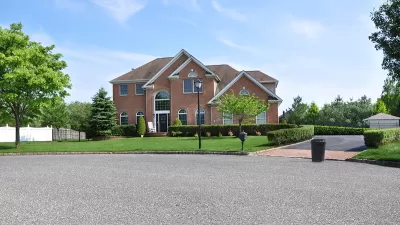
Joe Pinsker shares news of a new study published by the Social Science Research Network finding that Americans aren't happier, despite the ever-increasing size of new homes in the country.
“Despite a major upscaling of single-family houses since 1980,” writes Clément Bellet, a postdoctoral fellow at the European business school INSEAD, “house satisfaction has remained steady in American suburbs.”
Bellet places blame for the lack of happiness on the same effect described by the saying "keeping up with the Joneses": it's all about comparisons. Pinsker explains: "By [Bellet's] calculation, if homes in the 90th percentile were 10 percent bigger, the neighbors would be less pleased with their own homes unless those homes grew 10 percent as well. Moreover, the homeowners most sensitive to such shifts are the ones whose houses are in the second-biggest tier, not the ones whose houses are median-sized."
The article includes more detail on the findings and methodology of the study, and the study's implications for the built environment.
FULL STORY: Are McMansions Making People Any Happier?

Discretionary Approval for McMansions
Redwood City, located on the San Francisco Peninsula, will make it harder to build homes that take up more than 45 percent of a residential lot.

Accessory Dwelling Units as Mansionization Control
One benefit of more accessory dwelling units (ADUs) could be less mansionization of oversized single-family homes.
Mansionization Déjà Vu Reveals Differences of Opinion in Southern California
An editorial favors one local city's approach to mansionization over another's. When will they ever learn?

Planetizen Federal Action Tracker
A weekly monitor of how Trump’s orders and actions are impacting planners and planning in America.

The state-sanctioned urbicide of Austin
People don’t kill cities. Freeways do.

US to reduce Colorado River water deliveries to Mexico
A new Colorado Treaty amendment reduces Mexico’s Colorado River water allocation by 250,000 acre feet.

Mamdani overhauls NYC's Vision Zero plan with 100 new policy goals
The overhaul aims to reduce traffic deaths and make streets safer for pedestrians, cyclists and drivers through lower speed limits, new safety infrastructure and more.

Amtrak not solely to blame for New Jersey commuter rail's unreliability, report finds
A new study from the Garden State Initiative found that NJ Transit’s budget grew 20% across a 4 year period, but reliability declined significantly over the same period.

EPA erases limits on planet-warming pollution from power plants
Under Monday’s plan, power plants would still have some limits on how much mercury, arsenic and other contaminants they can emit.

FREE Course: Walkable City 1: Why Walkability?
After describing his path towards focusing on walkability as the essence of good planning, Jeff Speck marches through his five principal reasons for making more walkable places.
Reinventing Malls: Planning Alchemy—Turning Gray Fields Into Gold
The course focuses on the opportunities and imperatives that shape reinvention of mall sites.

Eagle County Government
Harvard University Graduate School of Design
Nashville Planning Department
The Architects Foundation
University of Cincinnati Online
The Pocatello Development Authority
The Urban Renewal Agency of the City of Pocatello
Journal of the American Planning Association