The Federal Energy Regulatory Commission (FERC) flies under the radar, but it makes some of the most consequential decisions about the federal government's approach to climate change.


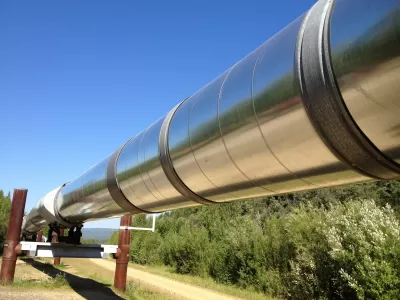
David Roberts interviews Richard Glick, commissioner of the Federal Energy Regulatory Commission (FERC), and Matthew Christiansen, a FERC advisor, to discover more about the powers of the little-known branch of the U.S. government to sway federal climate change policy.
"FERC sits at the heart of the clean energy transition, overseeing two key areas of frequent conflict," explains Roberts to introduce the interview. "The first is bulk electricity — interstate transmission lines and regional wholesale power markets. The second is natural gas infrastructure; the agency licenses the siting and building of all new pipelines."
The interview ranges from a discussion about the success of FERC's climate change efforts so far (on pipelines, Glick says FERC is doing poorly), how FERC might expand its abilities to address climate change, the uneasy relationship between FERC and states, the regulation of distributed power, and more.
For more details on the subjects covered in the interview, and more, see also an article written by Rich Glick and Matthew Christiansen for theEnergy Law Review.
Read the full story: This federal agency is quietly, profoundly shaping climate policy

The Inflation Reduction Act's Secret Climate Weapon
While the impact on inflation of the questionably-titled Inflation Reduction Act remains to be seen, the law will mitigate the damage done by a landmark Supreme Court case in June that gutted the EPA's authority to regulate greenhouse gas emissions.

Biden’s Environmental Legacy (So Far)
President Biden campaigned on promises to restore many of the environmental regulations rolled back by the previous administration, while promising new efforts to tackle environmental injustice and climate change.
Supreme Court Guts the U.S. EPA’s Ability to Limit Carbon Emissions
The consequences of this ruling have long been foretold. With the U.S. Environmental Protection Agency now officially barred from the fight against climate change, Congress will have to act to reduce carbon emissions.

Planetizen Federal Action Tracker
A weekly monitor of how Trump’s orders and actions are impacting planners and planning in America.

Amtrak, CN end decades-long dispute with eight-year agreement
The new operating agreement establishes an updated framework for the companies to work together, including processes to resolve disputes.

Judges permit Denver to divert 77,000 acre feet from the Colorado River for reservoir expansion
Overuse and climate change have caused the Colorado River’s water levels to plummet.

NYC DOT wants faster, more permanent street upgrades
The city is examining ways to build more concrete infrastructure without getting entangled in 'decades-long' projects.

'Something we’ve never seen before:' rising utility rates could strain city finances nationwide
Data centers, climate change and other factors have caused utility rates in the United States to increase by 38% since 2020.

Trump to overrule local leaders, lease millions of acres of America’s Pacific Island territories’ seafloors to mining companies
International law says that the Indigenous people of America’s territories have a right to prior and informed consent regarding projects that impact their countries.

FREE Course: Walkable City 1: Why Walkability?
After describing his path towards focusing on walkability as the essence of good planning, Jeff Speck marches through his five principal reasons for making more walkable places.
Reinventing Malls: Planning Alchemy—Turning Gray Fields Into Gold
The course focuses on the opportunities and imperatives that shape reinvention of mall sites.

Harvard University Graduate School of Design
KFH Group Inc.
Greater Baltimore Committee
The Architects Foundation
University of Cincinnati Online
The Pocatello Development Authority
The Urban Renewal Agency of the City of Pocatello