A law recently passed by the Oregon State Legislature redefines the ontology of bike lanes.


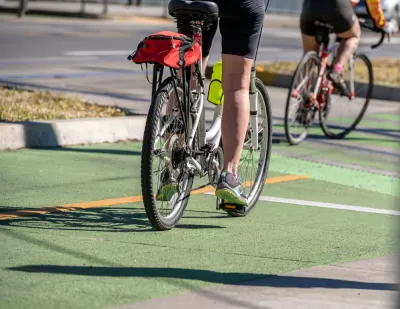
"Oregon lawmakers confirmed Monday that a bike lane still exists when interrupted by an intersection, despite the absence of paint on the roadway," reports Andrew Theen.
The ruling is more than a question of legal pedantry—it forces drivers to yield to people on bikes before turning. The legislation is also a "significant victory for bicycling advocates who have pushed for what they said was common sense legislation for years and called it their top priority in the 2019 legislative session."
In two previous cases, "judges determined drivers who hit bicyclists had not violated any right of way laws because bike lanes didn’t exist in an intersection," according to Theen.
Read the full story: Bike lanes exist in an intersection, Oregon lawmakers affirm

USDOT secretary plans to pull $1.73B from 'DEI bike lanes'
The move jeopardizes dozens of road safety projects around the country.
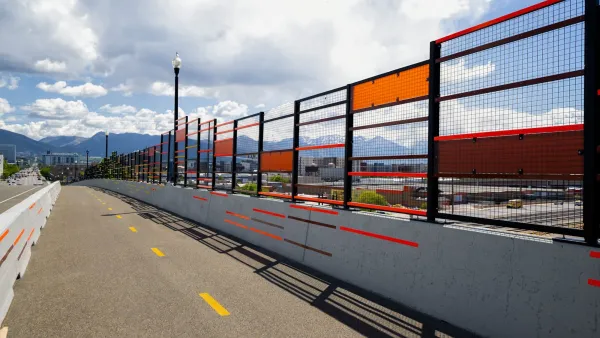
Salt Lake City opens protected bike path on viaduct trail
The 400 South Viaduct Trail features the state's longest continuous piece of public art.

Lawsuit Delays DC Bike Lane Closure Until at Least April
Crashes on 15th Street dropped by 46% since the bike lanes were added.

Planetizen Federal Action Tracker
A weekly monitor of how Trump’s orders and actions are impacting planners and planning in America.

Eastern Nebraska is running out of electricity
Data centers and electrification are straining eastern Nebraska’s grid, throttling economic development.

Study reveals best places in the U.S. for cycling, walking
New research from Streetlight Data examines bicycle and pedestrian miles per capita in the 100 largest U.S. cities by population.

Federal government nominates new FTA administrator
Mark Aesch is currently the founder and CEO of a transportation management consulting firm.

Developers reveal $10 billion stadium plan as ‘Hail Mary’ to keep Bears in Chicago
The plan would also boast a public park, high- and mid-rise buildings and a youth sports complex.

As Texas embraces carbon storage, a Black community questions the risks
Texas now issues permits for companies to store carbon dioxide underground. East Texas residents fear safety risks, and skeptics doubt the climate benefits.

FREE Course: Walkable City 1: Why Walkability?
After describing his path towards focusing on walkability as the essence of good planning, Jeff Speck marches through his five principal reasons for making more walkable places.
Reinventing Malls: Planning Alchemy—Turning Gray Fields Into Gold
The course focuses on the opportunities and imperatives that shape reinvention of mall sites.

City of Rosemead
Rutgers University, Edward J. Bloustein School of Planning and Public Policy
One Hundred Miles
University of Michigan School for Environment and Sustainability (SEAS)
Hunter College, City University of New York (CUNY)
The Architects Foundation
City of Cambridge
The Pocatello Development Authority
The Urban Renewal Agency of the City of Pocatello