A hybrid design (some protected lanes and some mixing with car traffic) is the preferred option for a planned bus rapid transit route on Pacific Avenue in Tacoma, Washington.


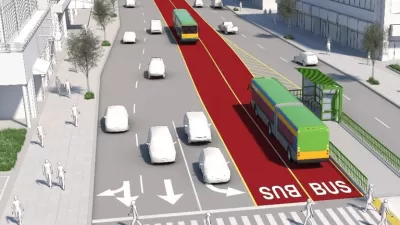
"Pierce Transit is moving ahead with a hybrid design for 14 miles of bus rapid transit (BRT) on Pacific Avenue [in Tacoma, Washington], including 3.6 miles of center-running dedicated lanes," reports Doug Trumm.
The Pierce Transit Board of Commissioners recently approved the hybrid plan, highlighting the pedestrian safety benefits of the options in discussions leading uo to the vote.
Still, the hybrid also makes room for cars by not using bus-only lanes along some of the route. It might have been even more of a car-friendly design, according to Trumm. "The other remaining option was business-access transit (BAT) lanes–in which buses share the right lane with turning motorists and scofflaws–throughout. Pierce Transit’s technical advisory committee recommended the all-BAT option. However, generally, transit advocates and urbanists preferred the hybrid option, in part for the transit oriented development potential it would unlock."
The $155 million project is expected to open in 2022.
FULL STORY: Tacoma’s Pacific Avenue Hybrid Bus Rapid Transit Advances

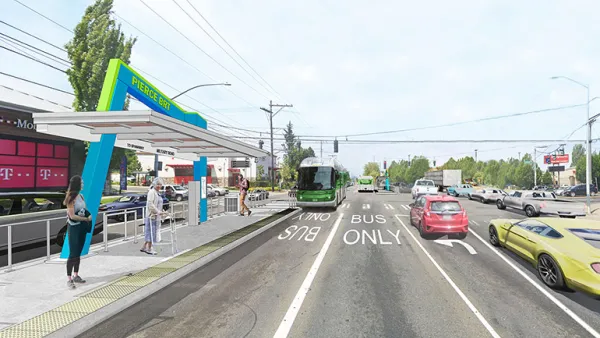
Bus Rapid Transit Plans Scrapped in Tacoma
A planned bus rapid transit (BRT) line known as “Stream” will have to move forward in some new, as-yet-unplanned form in Tacoma, Washington.
Bus Rapid Transit Upgrade Coming to Tacoma-Spanaway Route
Pierce Transit has committed to bus rapid transit to replace convention bus service on Route 1 between the two cities in Pierce County, Washington.
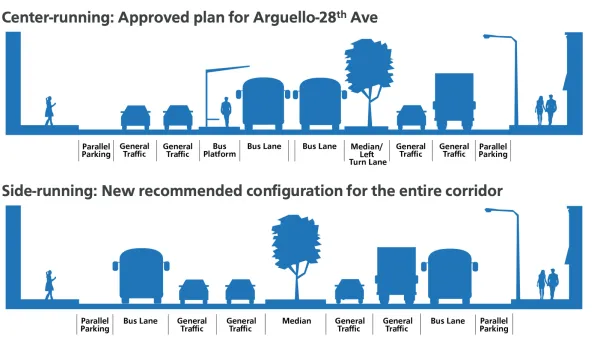
New Bus Only Lane Overcomes Opposition in San Francisco
Local business owners and the local elected official opposed the Geary transit-only lane project, but compromise and wide public support got the project across the finish line.

Planetizen Federal Action Tracker
A weekly monitor of how Trump’s orders and actions are impacting planners and planning in America.

The state-sanctioned urbicide of Austin
People don’t kill cities. Freeways do.

US to reduce Colorado River water deliveries to Mexico
A new Colorado Treaty amendment reduces Mexico’s Colorado River water allocation by 250,000 acre feet.

5 New England states march closer to 800 megawatt wind energy project
Securing federal approval for the project may be complicated under the Trump administration, which has historically been hostile towards domestic wind power.

Baltimore to break ground on $50 million Transit Priority Project
The project will bring faster bus trips, safer streets and better bike connections to Baltimore.

Airbnb launches $250 million 'last-dollar financing' housing accelerator, makes first investment in Austin
The company will put $6.4 million towards affordable housing development in Texas’ capital.

FREE Course: Walkable City 1: Why Walkability?
After describing his path towards focusing on walkability as the essence of good planning, Jeff Speck marches through his five principal reasons for making more walkable places.
Reinventing Malls: Planning Alchemy—Turning Gray Fields Into Gold
The course focuses on the opportunities and imperatives that shape reinvention of mall sites.

Eagle County Government
Harvard University Graduate School of Design
Nashville Planning Department
The Architects Foundation
University of Cincinnati Online
The Pocatello Development Authority
The Urban Renewal Agency of the City of Pocatello
Journal of the American Planning Association