Richard Florida counters the idea that children and families are disappearing from U.S. cities.



In CityLab, Richard Florida addresses the "growing consensus" that American cities are losing their populations of children and families. While some data has suggested that the number of families with children has fallen in 53 large cities, new data suggests that most big cities aren't far off the national average—including major urban centers like New York and Los Angeles.
Looking at the 2016 American Communities Survey, Florida identifies the following trends:
"The places with the largest shares of families with kids—where families with kids range from more than half to 70 percent of all households—are mainly smaller cities that are home to military bases, like Fort Knox, Kentucky, or agricultural communities with high percentages of immigrant families, like Watsonville, California.
Looking at the most-childless cities of any size, that list (below) skews heavily toward retirement destinations in Florida and college towns such as State College, Pennsylvania. In other words, these are places you’d expect to have fewer households with children under 18, so they don’t support the case that U.S. cities are becoming more childless."
FULL STORY: Which U.S. Cities Have the Most Families With Kids?

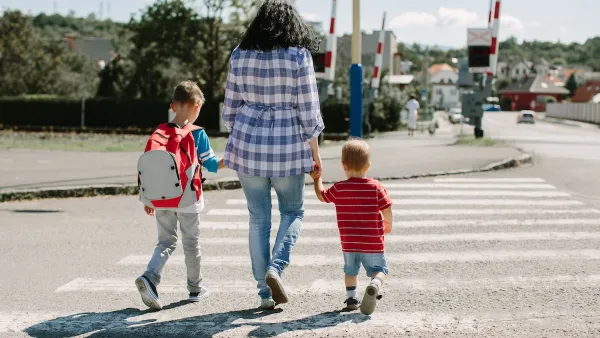
How Urban Design Can Benefit Parents and Kids
Designing thoughtful, child-friendly public spaces can ease the burdens of modern parenting and offer safe spaces for children to learn self-reliance and resilience.

How Courtyard Apartments Make Cities More Family-Friendly
Apartment buildings with interior courtyards can offer safe, affordable, and functional spaces for urban households with children.

Kids and Urbanization
The question of whether there is space for children in rapidly changing cities was under investigation in two recent studies with somewhat contradictory findings.

Planetizen Federal Action Tracker
A weekly monitor of how Trump’s orders and actions are impacting planners and planning in America.

The state-sanctioned urbicide of Austin
People don’t kill cities. Freeways do.

US to reduce Colorado River water deliveries to Mexico
A new Colorado Treaty amendment reduces Mexico’s Colorado River water allocation by 250,000 acre feet.

5 New England states march closer to 800 megawatt wind energy project
Securing federal approval for the project may be complicated under the Trump administration, which has historically been hostile towards domestic wind power.

Baltimore to break ground on $50 million Transit Priority Project
The project will bring faster bus trips, safer streets and better bike connections to Baltimore.

Airbnb launches $250 million 'last-dollar financing' housing accelerator, makes first investment in Austin
The company will put $6.4 million towards affordable housing development in Texas’ capital.

FREE Course: Walkable City 1: Why Walkability?
After describing his path towards focusing on walkability as the essence of good planning, Jeff Speck marches through his five principal reasons for making more walkable places.
Reinventing Malls: Planning Alchemy—Turning Gray Fields Into Gold
The course focuses on the opportunities and imperatives that shape reinvention of mall sites.

Eagle County Government
Harvard University Graduate School of Design
Nashville Planning Department
The Architects Foundation
University of Cincinnati Online
The Pocatello Development Authority
The Urban Renewal Agency of the City of Pocatello
Journal of the American Planning Association