The Chinese company seemed to be dominating its corner of the shared mobility market—until its dramatic downfall.


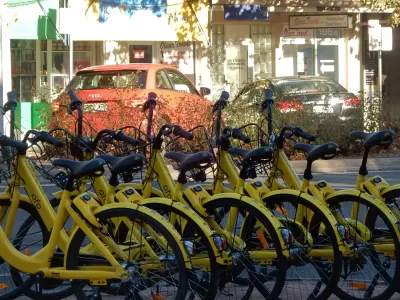
Ofo bikes were once ubiquitous in China and located in over 20 other countries around the world, but the company now may be headed toward bankruptcy. "Ofo was a phenomenon. Its dockless bicycles, which could be picked up by scanning a QR code and left anywhere, grew from Beijing campuses to become an icon of young, urban cool. The firm garnered a valuation of US$2-billion," report Pei Li and Josh Horwitz.
The specific cause of Ofo’s problems isn’t entirely clear. The company grew quickly, and some say it happened too fast. Ofo also faced a host of smaller competitors, many of which have gone out of business, and the fight to stay on top contributed to cost overruns. In addition, a plan to expand into Japan fell through, and its operations have been hindered by local traffic regulations and vandalism.
The Ofo situation has Chinese tech investors worried, and Chinese consumers are unhappy as well. "In China, once-loyal users have turned on Ofo, lining up at its offices in Beijing to demand the return of deposits paid upfront to use the service. More than 12 million people have so far requested repayment online," say Li and Horwitz.
FULL STORY: The rise and fall of bike-sharing company Ofo is a lesson for China’s tech investors


On the Pitfalls of Dockless Bikeshare
App-driven bikeshare, without the station, has been spreading rapidly, especially in China. But the system comes with its share of problems, including its own version of the tragedy of the commons.
Next From China: Bikeshare Without the Station
Led by the companies Mobike and Ofo, so-called "dockless" bike sharing is all the rage in Chinese cities. Unlocked by app, the bikes can be left anywhere for the next user to pick up. There have been some hiccups.
Dockless Bikeshare Service Launches in St. Louis, With City's Blessing
The city of St. Louis has launched a permitting system for dockless bikeshare companies LimeBike and Ofo to operate.

Planetizen Federal Action Tracker
A weekly monitor of how Trump’s orders and actions are impacting planners and planning in America.

The state-sanctioned urbicide of Austin
People don’t kill cities. Freeways do.

US to reduce Colorado River water deliveries to Mexico
A new Colorado Treaty amendment reduces Mexico’s Colorado River water allocation by 250,000 acre feet.

Mamdani overhauls NYC's Vision Zero plan with 100 new policy goals
The overhaul aims to reduce traffic deaths and make streets safer for pedestrians, cyclists and drivers through lower speed limits, new safety infrastructure and more.

Amtrak not solely to blame for New Jersey commuter rail's unreliability, report finds
A new study from the Garden State Initiative found that NJ Transit’s budget grew 20% across a 4 year period, but reliability declined significantly over the same period.

EPA erases limits on planet-warming pollution from power plants
Under Monday’s plan, power plants would still have some limits on how much mercury, arsenic and other contaminants they can emit.

FREE Course: Walkable City 1: Why Walkability?
After describing his path towards focusing on walkability as the essence of good planning, Jeff Speck marches through his five principal reasons for making more walkable places.
Reinventing Malls: Planning Alchemy—Turning Gray Fields Into Gold
The course focuses on the opportunities and imperatives that shape reinvention of mall sites.

Eagle County Government
Harvard University Graduate School of Design
Nashville Planning Department
The Architects Foundation
University of Cincinnati Online
The Pocatello Development Authority
The Urban Renewal Agency of the City of Pocatello
Journal of the American Planning Association