The official case for repealing car fuel-economy rules is so full of errors it will be hard to defend in court.


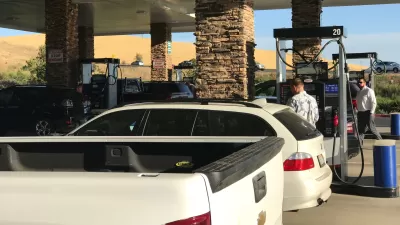
Robinson Meyer shares details of the curious case of the Trump administration's attempt to appeal car fuel-economy standards put in place during the Obama administration.
The Trump administration’s official case for repealing car fuel-economy rules is riddled with calculation mistakes, indefensible assumptions, and broken computer models, according to economists, environmental groups, and a major automaker. The errors may seriously endanger the rule, hampering the White House’s ability to prove the proposal’s benefits exceed its costs and raising questions about whether it can survive an almost inevitable court challenge.
The mistakes range in scope from the comical to the bizarre, from the obviously accidental to the how-did-they-miss-that. In one case, federal employees have forgotten to divide a crucial figure by four. In another, officials have assumed that raising the cost of cars will lead more people to buy them, a violation of the principle of supply and demand. In a third case, the proposal asserts that freezing fuel-economy standards for new cars will lead the owners of old cars to drive their vehicles less.
What's more, every single error seems to tilt the analysis in the Trump administration's favor, according to Meyer's sources. Mistakes like that will make it very difficult to support the Trump administration's proposal when it inevitably faces a lawsuit.
In some cases, the mistakes are so large—and so central to the rule’s legal justification—that remedying them may destabilize the entire argument for the proposal. Public documents also make it clear that the Trump administration knew about some of the errors before the rollback was published.
Meanwhile, General Motors and Honda have broken ranks from the previous universal support for the Trump administration's moves to undo the Obama-era fuel economy rules. Ryan Beene and John Lippert report in a separate article:
General Motors Co. plans to propose that instead of opposing California’s so-called zero emission vehicle sales mandate, federal regulators should instead embrace a nationwide electric-car sales program starting in 2021. Honda Motor Co., meanwhile, took exception to Trump’s proposed freeze on mileage standards and called for steadily increasing requirements to continue.
FULL STORY: The Trump Administration Flunked Its Math Homework

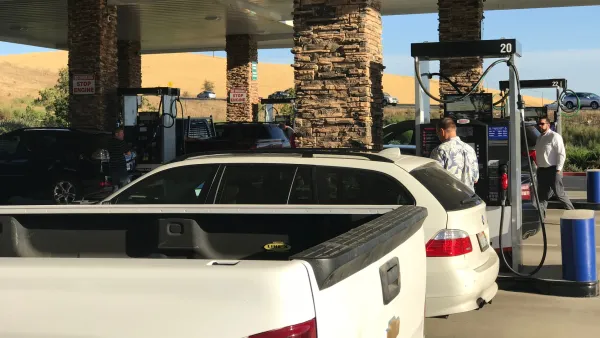
Coming Soon: Trump's Revised Fuel Efficiency Standards
The Trump administration has submitted revised fuel efficiency standards to the White House Office of Management and Budget for a final review. If approved, the rule would overturn a key environmental initiative of the Obama administration.
Trump Administration Clashes on Vehicle Emissions Standards Rollback
It's the U.S. EPA, under the new acting administrator, against two top officers in the Department of Transportation. Both agencies (along with California) determine fuel efficiency standards. Guess which wants to proceed cautiously in the rollback?
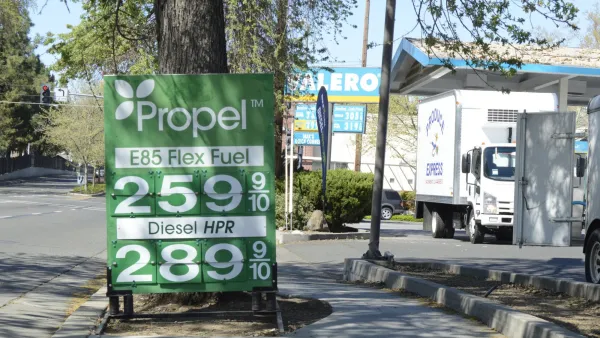
California and Auto Industry Agree on Vehicle Emissions Standards
Normally having the California Air Resources Board and the auto industry in agreement on emissions standards would be enough, but the Trump administration wants to ensure that California plays no role in setting standards.

Planetizen Federal Action Tracker
A weekly monitor of how Trump’s orders and actions are impacting planners and planning in America.

The state-sanctioned urbicide of Austin
People don’t kill cities. Freeways do.

US to reduce Colorado River water deliveries to Mexico
A new Colorado Treaty amendment reduces Mexico’s Colorado River water allocation by 250,000 acre feet.

5 New England states march closer to 800 megawatt wind energy project
Securing federal approval for the project may be complicated under the Trump administration, which has historically been hostile towards domestic wind power.

Baltimore to break ground on $50 million Transit Priority Project
The project will bring faster bus trips, safer streets and better bike connections to Baltimore.

Airbnb launches $250 million 'last-dollar financing' housing accelerator, makes first investment in Austin
The company will put $6.4 million towards affordable housing development in Texas’ capital.

FREE Course: Walkable City 1: Why Walkability?
After describing his path towards focusing on walkability as the essence of good planning, Jeff Speck marches through his five principal reasons for making more walkable places.
Reinventing Malls: Planning Alchemy—Turning Gray Fields Into Gold
The course focuses on the opportunities and imperatives that shape reinvention of mall sites.

Eagle County Government
Harvard University Graduate School of Design
Nashville Planning Department
The Architects Foundation
University of Cincinnati Online
The Pocatello Development Authority
The Urban Renewal Agency of the City of Pocatello
Journal of the American Planning Association