Mayor Rahm Emanuel's administration will expand its program to incentivize transit oriented development by including land around the 79th Street and Chicago Avenue bus routes.


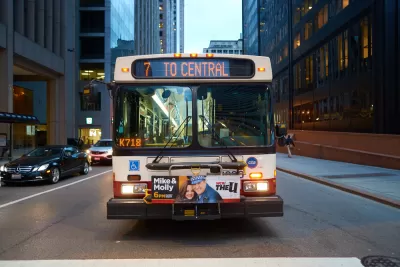
The city of Chicago's transit oriented development (TOD) program will expand to include South Side and West Side neighborhoods around bus lines. In TOD areas in Chicago, zoning regulations wave some of the restrictions around parking allocations and number of units. "One goal of transit-oriented development is to increase housing near CTA and Metra stations so that people walk and use public transportation more frequently. In this most recent expansion of the policy, Chicago would be the first city to implement transit-oriented development around bus lines, according to the mayor’s office," Sara Freund explains for Curbed Chicago.
"The two bus corridors were selected by the city due to high ridership—No. 66 Chicago Avenue line saw 6.9 million riders in 2017 and No. 79 79th Street route had 7.8 million riders in the same year," Freund reports. Where, exactly, on those lines the TODs will fall has yet to be determined.
Read the full story: Transit-oriented development expands to bus corridors on South, West sides
Chicago to Pilot All-Door Bus Boarding
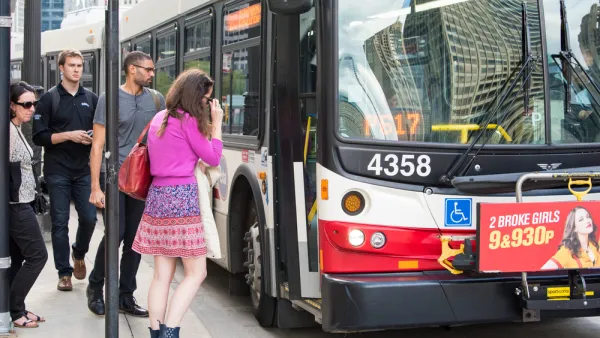
Chicago is late to the game on all-door bus boarding, but that will change this summer.
Bus/Bike Lanes Find Support in Chicago
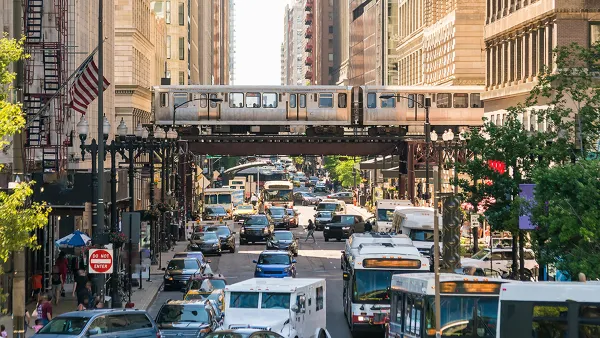
A temporary bus/bike lane experiment could lead to permanent additions around the city.
Chicago Transit Authority Buses Inch Toward Prepay
A Chicago Transit Authority pilot program for prepayment is set to expand. Transit advocates can't wait for the agency to adopt the program around the city.

Planetizen Federal Action Tracker
A weekly monitor of how Trump’s orders and actions are impacting planners and planning in America.

Washington state to charge fee to drivers with fuel-efficient cars
Revenue from the fee will go towards supporting the state’s highways.

Study reveals best places in the U.S. for cycling, walking
New research from Streetlight Data examines bicycle and pedestrian miles per capita in the 100 largest U.S. cities by population.

Mamdani unveils his ‘most ambitious bus lane project’ so far
The city has added two new bus lanes, which it expects to speed up tens of thousands of bus riders’ commutes.

New Jersey and New York suggest $10.3 billion budget for transit
Some of the budget is dedicated to replacing Manhattan's Midtown Bus Terminal.

States split over EPA’s proposal to drop greenhouse gas rules for power plants
The proposed rule drew over 165K comments, including from officials, health and environmental groups, and private citizens.

FREE Course: Walkable City 1: Why Walkability?
After describing his path towards focusing on walkability as the essence of good planning, Jeff Speck marches through his five principal reasons for making more walkable places.
Reinventing Malls: Planning Alchemy—Turning Gray Fields Into Gold
The course focuses on the opportunities and imperatives that shape reinvention of mall sites.

City of Charlotte
City of Rosemead
Rutgers University, Edward J. Bloustein School of Planning and Public Policy
University of Michigan School for Environment and Sustainability (SEAS)
Hunter College, City University of New York (CUNY)
The Architects Foundation
University District Partnership
City of Cambridge
The Pocatello Development Authority