Pennsylvania legislation would make it harder for communities to regulate the new wireless network infrastructure.


Jim Saksa reports on the tensions arising between wireless network builders and local municipalities as 5G networks expand on small-cell infrastructure that relies on smaller antennas and connection boxes. As companies like Crown Castle International Inc. scramble to get this infrastructure up ahead of the release of 5G smartphones next year, some towns and cities are objecting to what gets put where.
State legislation in Pennsylvania would streamline the application review and approval process and make it easier for companies like Crown Castle:
The bill would curtail local government’s ability to regulate the placement of small-cell infrastructure along public rights-of-way such as streets. It would effectively treat companies like Crown Castle as utilities — something Commonwealth Court recently ruled they are, reversing the Pennsylvania Public Utility Commission’s ruling that they were not — thus allowing them more leeway to do what they want in public spaces than other, non-utility companies are permitted.
Wireless infrastructure companies are going to start in areas most receptive to the new networks, primarily more populated areas. But supporters of the bill say a more uniform regulatory system will ensure that particular municipalities will not hold up development of the broader network. Opponents argue, however, that there should be a compromise because they are “not philosophically opposed to the idea of surrendering a bit of local control over the streetscape to speed along technological advancement,” says Saksa.
FULL STORY: Bill seeks to streamline faster wireless broadband, steamroll local control of the streetscape


Pennsylvania’s Historic Sites are Under Threat From Rising Waters
The state has one of the nation’s highest concentrations of registered historic sites — and some face destruction from flooding.
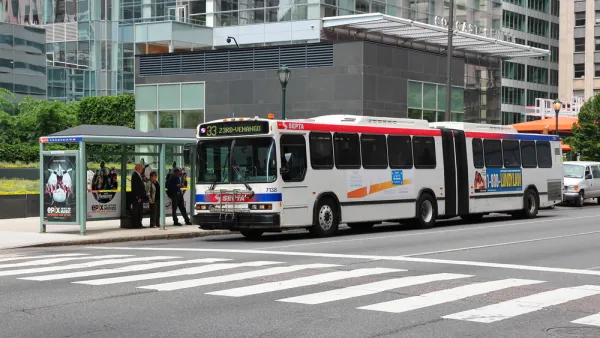
How Pennsylvania Will Benefit From Federal Transit Funding
Pennsylvania is set to receive over $600 million for public transit and mobility, but state leaders have yet to make decisions about specific projects.

Is the Pandemic Improving Affordable Housing Asset Management?
Resident services has long been the first to be cut in hard times—but for some housing providers that may be changing.

Planetizen Federal Action Tracker
A weekly monitor of how Trump’s orders and actions are impacting planners and planning in America.

The state-sanctioned urbicide of Austin
People don’t kill cities. Freeways do.

US to reduce Colorado River water deliveries to Mexico
A new Colorado Treaty amendment reduces Mexico’s Colorado River water allocation by 250,000 acre feet.

5 New England states march closer to 800 megawatt wind energy project
Securing federal approval for the project may be complicated under the Trump administration, which has historically been hostile towards domestic wind power.

Baltimore to break ground on $50 million Transit Priority Project
The project will bring faster bus trips, safer streets and better bike connections to Baltimore.

Airbnb launches $250 million 'last-dollar financing' housing accelerator, makes first investment in Austin
The company will put $6.4 million towards affordable housing development in Texas’ capital.

FREE Course: Walkable City 1: Why Walkability?
After describing his path towards focusing on walkability as the essence of good planning, Jeff Speck marches through his five principal reasons for making more walkable places.
Reinventing Malls: Planning Alchemy—Turning Gray Fields Into Gold
The course focuses on the opportunities and imperatives that shape reinvention of mall sites.

.jpg)
Eagle County Government
Harvard University Graduate School of Design
Nashville Planning Department
The Architects Foundation
University of Cincinnati Online
The Pocatello Development Authority
The Urban Renewal Agency of the City of Pocatello
Journal of the American Planning Association