Developers hope 5G infrastructure will make Frisco Station a hub for self-driving cars, air taxis, and other futuristic technologies.


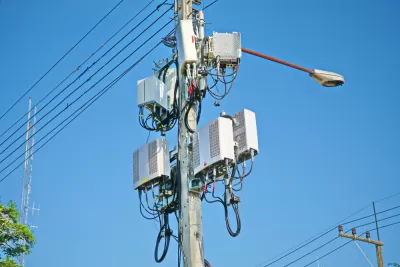
A $1.5 billion development in North Texas will become one of the first to include 5G infrastructure from the ground up, the Dallas News reports. Frisco Station, a master-planned community in a booming part of North Texas, will be constructed to accommodate the next-generation mobile network thanks to a partnership with AT&T.
Incorporating the infrastructure for 5G—which is expected to debut in Dallas and other major markets at the end of this year—is intended to futureproof the development, allowing it to host future technologies that require faster and more robust internet service than existing infrastructure can offer. The goal is to create a cutting-edge environment that will attract and retain an elite workforce, writer Melissa Repko reports.
The infrastructure, which uses dense fiber and small cells, will help make the developers' vision for Frisco Station possible. Along with apartments and hotels, the site will include a 30-acre park with public Wi-Fi. Nearby, developer Hillwood and tech giant Uber plan to build a transit station where people can board an urban air taxi that shuttles them through the skies. And in the future, self-driving cars may roll around the development to pick up and drop off people. Silicon Valley-based Drive.ai is already testing its autonomous vehicles by driving around employees of Hall Park, a neighboring office campus.
Read the full story: Frisco's $1.5B planned community is one of country's first built from the ground up for 5G

Big Public-Private Partnership to Reset Internet Infrastructure in San Jose
The city of San Jose's Broadband and Digital Inclusion Strategy is leveraging the private sector to ensure broad inclusion of new Internet technology.
The 'Worst-Connected Cities' in the United States
Here are the cities where residents are the least likely to have a broadband Internet connection in their home.
Feds Streamline Approvals for 5G Infrastructure
Most deployment of 5G "small cells" won't get any resistance from federal regulations.

Planetizen Federal Action Tracker
A weekly monitor of how Trump’s orders and actions are impacting planners and planning in America.

Data reveals that NYC’s bet on congestion pricing has paid off
After almost two years of the program, reports show positive impacts on traffic and air quality and no disruptions to parking.

Denver is solving homelessness. Why aren't the rest of us?
Since 2023, Denver's street homeless population has decreased by 64%, proving that effective tools exist to support those in need of housing.

Michigan needs billions to save its water infrastructure. The state won't fund it
Michigan needs to invest $2.8 billion per year over the next 20 years to fix its water infrastructure. The FY 2027 budget allocates only $27.9 million.

Trump asks Supreme Court to allow border wall through Texas national park
Judge Kathleen Cardone previously blocked the Big Bend border wall project, and Texas’ Land Commissioner has spoken out against it as well.

This MA town is drowning in its own sewage — and residents like it that way
Susan Murcott, a waste water expert, said if Carlisle didn't address their leaking sewage, the problem could turn “deadly.”

FREE Course: Walkable City 1: Why Walkability?
After describing his path towards focusing on walkability as the essence of good planning, Jeff Speck marches through his five principal reasons for making more walkable places.
Reinventing Malls: Planning Alchemy—Turning Gray Fields Into Gold
The course focuses on the opportunities and imperatives that shape reinvention of mall sites.

City of Rosemead
Rutgers University, Edward J. Bloustein School of Planning and Public Policy
One Hundred Miles
The Architects Foundation
University of Cincinnati Online
Montrose County
Northern Illinois Transit Authority (NITA)
The Pocatello Development Authority