Steep tariffs and tight federal laws haven’t stopped Waymo from purchasing over 3,200 vehicles from Zeekr, a Chinese manufacturer.


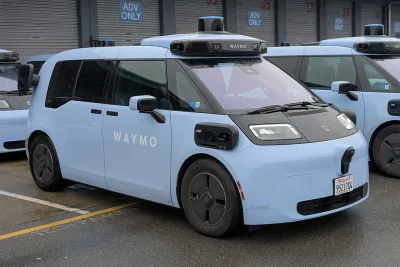
United States tariffs and federal law effectively prevent Americans from buying Chinese-made electric vehicles — but not from hailing them as robotaxis. Through a series of workarounds, Waymo has brought Ojais, self driving EVs manufactured in China by Zeekr, to the United States. Select passengers have been riding in Ojais since May 28; now, the cars are able to pick up all Waymo riders — and soon, people will be able to request them specifically.
“Waymo has brought more than 3,200 Zeekr vehicles into the US through the Port of Los Angeles since 2024, with more than 2,600 of those arriving in 2026 alone — all while paying a tariff of roughly 127.5% on Chinese EVs,” Fred Lambert writes for Electrek.
The Ojai’s base price is believed to be worth it: Waymo’s sensors and computing suite are what add the real value to the vehicle, and those aren’t added until the cars are in America, as the US Commerce Department’s connected-vehicle rule bans vehicle-connectivity and driver-assist hardware or software sourced from China or Russia. In total, the Ojai’s cost is still expected to be less than half of Waymo’s standard Jaguar I-PACE cars.
The Ojai vehicles have extra headroom and legroom compared to the Jaguar I-PACE cars, as well as a low step-in height and sliding doors. The vehicles also feature charging ports, braille labeling and three screens that show the route and allow users to alter the car’s climate and music.
Read the full story, below.
Read the full story: You can now ride a Chinese EV in the US as Waymo opens Zeekr Ojai to all

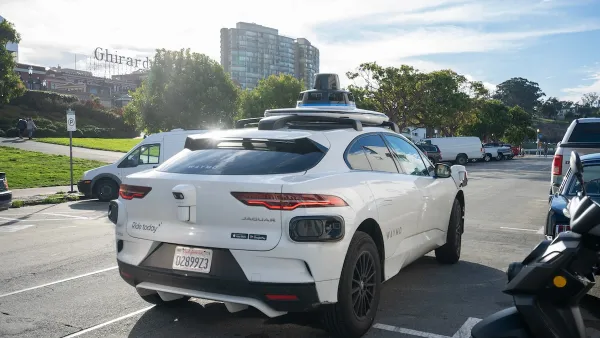
Robotaxi Charging Lots Could Complicate San Francisco Housing Development
Multiple sites slated for housing development are now being turned into charging and storage lots for autonomous vehicles, making housing an unintended victim of the robotaxi revolution.
China Becomes Unlikely Model for Sustainability
The Chinese government has been employing a bottom-up approach to sustainability through pilot programs in individual cities, boosting investment in clean energy by 20 percent since last year.
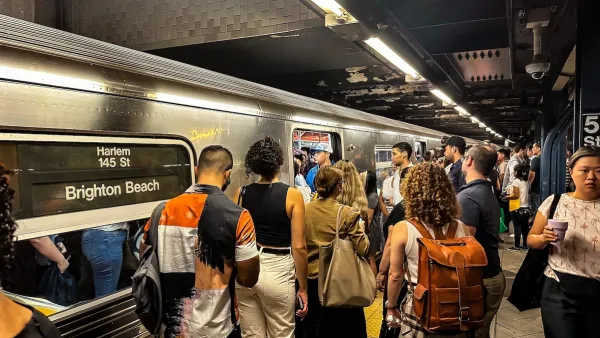
MTA expects Trump’s tariffs to increase new NYC transit costs by $1 billion
The Metropolitan Transit Authority said the cost of new subway cars has risen by 30% since Trump began his second term as president.

Planetizen Federal Action Tracker
A weekly monitor of how Trump’s orders and actions are impacting planners and planning in America.

‘Going backwards:’ Baltimore mayor, students rally against state's transit funding plan
Maryland's proposed six-year plan provides no funding for Baltimore’s BMORE bus program and reduces its road maintenance funding.

Detroit to transform waterfront with $2.2 billion investment
Developers will convert about 18 acres of unused parking lot space into civic spaces.

HUD, USDA agree on framework to simplify housing environmental review standards
Their agreement is a requirement of the 21st Century ROAD to Housing Act.

Cost of water rising at a faster pace than inflation, median household income
California and Maryland residents have seen their water bills grow especially high.

NYC building owners overwhelmingly comply with new emissions limits
The New York City Department of Buildings is fining owners who did not file emissions reports.

FREE Course: Walkable City 1: Why Walkability?
After describing his path towards focusing on walkability as the essence of good planning, Jeff Speck marches through his five principal reasons for making more walkable places.
Reinventing Malls: Planning Alchemy—Turning Gray Fields Into Gold
The course focuses on the opportunities and imperatives that shape reinvention of mall sites.

planning NEXT
City of Thousand Oaks
City of Wisconsin Rapids
The Architects Foundation
University of Cincinnati Online
Northern Illinois Transit Authority (NITA)
The Pocatello Development Authority
The Urban Renewal Agency of the City of Pocatello