The agency is exploring ways to monitor its thousands of cameras to quickly detect potential threats.


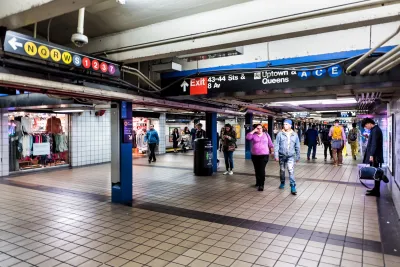
New York City’s Metropolitan Transportation Authority (MTA) is gathering proposals from tech companies to understand how the agency can use AI to monitor the security cameras and sensors in its transit system. As Jose Martinez explains in The City, “There are more than 15,000 cameras throughout the entire transit system and on the more than 6,000 cars in the subway fleet.” With so many feeds, the MTA acknowledges that “current monitoring practices remain manual, reactive and resource intensive.”
According to Martinez, “The request spells out early steps in the MTA’s shift toward possibly using AI to perform complex public-safety work, such as analyzing real-time video feeds from subways and buses and predicting potentially unsafe behavior via cameras in the transit system.”
Technology experts warn that AI comes with its own ethical and logistical risks. In a 2024 weapons detection pilot program, a monthlong test with more than 3,000 searches at 20 stations using AI-powered scanners turned up 12 knives, no guns, and over 100 false positives.
Martinez notes that the MTA’s request for proposals does not mention highly controversial facial recognition technology. However, “The document adds that the MTA is aiming for that monitoring setup to evolve into a ‘proactive intelligence-driven ecosystem, capable of flagging behavior, risk assessment and incident response.’” Jerome Greco, supervising attorney of The Legal Aid Society’s Digital Forensics Unit, says this prompts concerns about what defines “unusual” or “unsafe” behavior. “Are we essentially now policing people for being strange?”
FULL STORY: MTA Explores How to Use AI to Monitor Thousands of Cameras in Transit System

NYC Subway Had its Safest Year in Almost 20 Years — and Riders Noticed
A majority of passengers say they feel safe on trains and in stations.
Judge Blocks Trump Cuts to MTA Security Funding
A judge halted the Trump administration’s attempt to withhold transit security funds.
Feds Deny NYC ‘Every Dollar’ of Transit Security Funding Due to ‘Sanctuary’ Status
DHS denied the MTA its request for funding under the Transit Security Grant Program despite the administration’s concern with transit safety.

Planetizen Federal Action Tracker
A weekly monitor of how Trump’s orders and actions are impacting planners and planning in America.

The state-sanctioned urbicide of Austin
People don’t kill cities. Freeways do.

US to reduce Colorado River water deliveries to Mexico
A new Colorado Treaty amendment reduces Mexico’s Colorado River water allocation by 250,000 acre feet.

5 New England states march closer to 800 megawatt wind energy project
Securing federal approval for the project may be complicated under the Trump administration, which has historically been hostile towards domestic wind power.

Baltimore to break ground on $50 million Transit Priority Project
The project will bring faster bus trips, safer streets and better bike connections to Baltimore.

Airbnb launches $250 million 'last-dollar financing' housing accelerator, makes first investment in Austin
The company will put $6.4 million towards affordable housing development in Texas’ capital.

FREE Course: Walkable City 1: Why Walkability?
After describing his path towards focusing on walkability as the essence of good planning, Jeff Speck marches through his five principal reasons for making more walkable places.
Reinventing Malls: Planning Alchemy—Turning Gray Fields Into Gold
The course focuses on the opportunities and imperatives that shape reinvention of mall sites.

Eagle County Government
Harvard University Graduate School of Design
Nashville Planning Department
The Architects Foundation
University of Cincinnati Online
The Pocatello Development Authority
The Urban Renewal Agency of the City of Pocatello
Journal of the American Planning Association