A streetscape redesign spearheaded by the Downtown Brooklyn Partnership has quickly made many of Brooklyn’s streets unrecognizable.


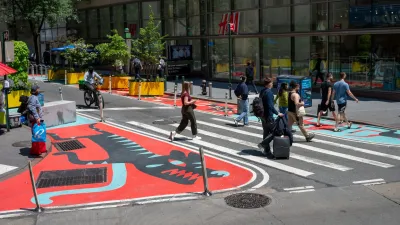
Downtown Brooklyn is undergoing a transformation, going from a business and shipping district to a round-the-clock residential neighborhood.
As Nate Berg explains in Fast Company, the Downtown Brooklyn Partnership (DBP) hired a design firm to reimagine the area’s streetscapes to make them greener and more pedestrian-friendly. “Now, after seven years of planning and prototypes, the designs have been fully installed.”
The project, which added planters, bollards, public seating, seating, traffic calming measures, and increased greenery, began with two small prototypes that led the city to devote $40 million to further improvements. According to Berg, “This could be just the start of a broader transformation in the area. WXY and BIG’s design has now become a system that developers can use to improve the streetscape of future projects.”
The design was intentionally “minimal in its proposed interventions,” requiring little large-scale construction and using existing infrastructure. “The plan has sailed through approvals and construction, and downtown Brooklyn’s streetscapes are almost unrecognizable from what they looked like just a few years ago.”
Read the full story: This busy NYC neighborhood just got way more walkable


Meet NYC’s New Office of Livable Streets
The NYC DOT program will build on pandemic-era initiatives to promote safe and comfortable streets that enhance community and expand uses beyond just moving cars.
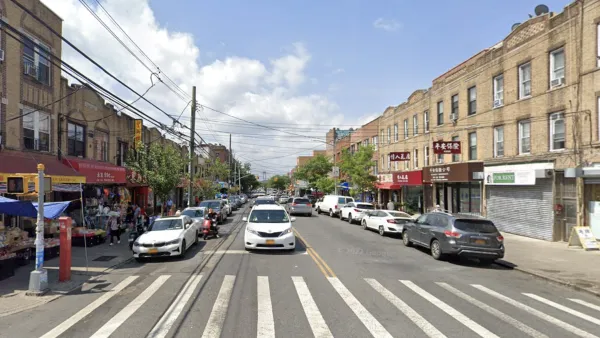
DOT Scraps Safety Plan for Two Brooklyn Avenues
An ambitious proposal to build protected bike lanes and install traffic calming measures on two dangerous Brooklyn avenues has been nixed by the agency, which plans to develop a new proposal in the coming months.

Bold Plans Unveiled for Converting Durham's Historic Downtown Loop
The city of Durham hosted a public workshop this week to discuss urban design plans for converting a circuitous couplet to a two-way street grid.

Planetizen Federal Action Tracker
A weekly monitor of how Trump’s orders and actions are impacting planners and planning in America.

California plans to bury El Niño’s downpour
If the state plays its cards right, it may be able to store a billion acre-feet of El Niño’s water in aquifers.

Chicago breaks ground on $3 billion megadevelopment
The new neighborhood, titled Foundry Park, will one day host 3,700 residences.

Satanic Place Names
From streams and lakes to valleys and canyons, I mapped more than 1,000 places named after the Devil.

California High-Speed Rail Authority CEO resigns after $600,000 scandal
Under Ian Choudri, the authority used taxpayer dollars to fund first class flights and trips to nightclubs.

Want to study the Missouri River? Soon, you may need unanimous approval from 10 states
Legislation would require 10 governors’ permission to study or build projects moving water outside the basin.

FREE Course: Walkable City 1: Why Walkability?
After describing his path towards focusing on walkability as the essence of good planning, Jeff Speck marches through his five principal reasons for making more walkable places.
Reinventing Malls: Planning Alchemy—Turning Gray Fields Into Gold
The course focuses on the opportunities and imperatives that shape reinvention of mall sites.

City of Rosemead
Rutgers University, Edward J. Bloustein School of Planning and Public Policy
One Hundred Miles
Hunter College, City University of New York (CUNY)
The Architects Foundation
University of Cincinnati Online
City of Cambridge
Montrose County
The Pocatello Development Authority