The train returns 23% of the power it generates to the state’s grid, powering homes and businesses along its route.


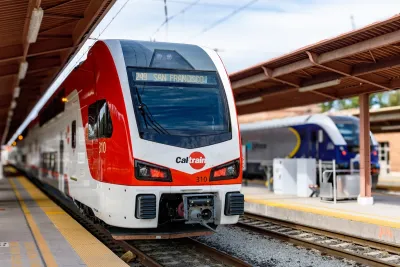
Northern California’s Caltrain commuter rail line, which recently introduced electric trains, will start receiving roughly $1 million annually for the power it returns to the grid starting in April 2026, offering a potential model for a new source of transit funding.
As an article in Metro Magazine explains, “Currently, Caltrain returns approximately 23% of the power it uses back to the power grid, providing power to residents and businesses along its corridor.” A new state law, AB 1372, requires utilities to compensate railroads for energy they return to the grid.
Regenerative braking isn’t new technology: it was first introduced in trains in 1886, according to Caltrain. But these systems were in disuse until now. “They work by driving an electric motor in reverse to recapture energy rather than losing it as heat during braking. Caltrain's fleet is designed to return that power to the Overhead Contact System (OCS), which feeds it to the nearest traction power facility.”
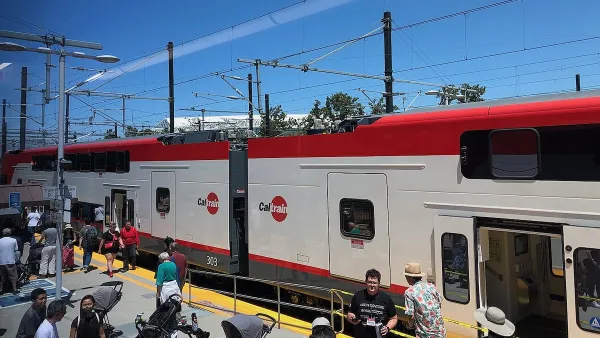
The electrification project also improved service and ridership on the line, which saw a 76 percent increase in passengers between June 2024 and June 2025.
FULL STORY: Caltrain's Electric Trains Now Earn Money While Powering the Grid

Electrified Caltrain Boosts Ridership 76%
The introduction of electric trains and faster, more frequent service has led to a dramatic increase in ridership.
Passengers Flock to Caltrain After Electrification
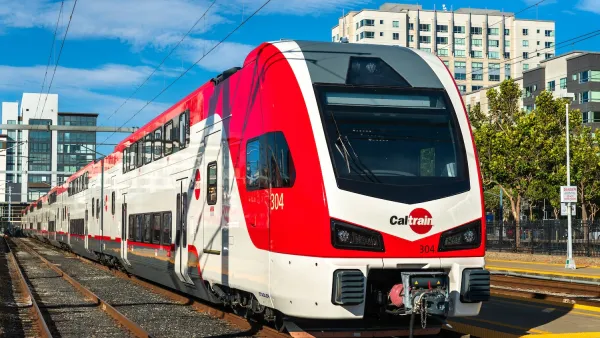
The new electric trains are running faster and more reliably, leading to strong ridership growth on the Bay Area rail system.
Caltrain Ridership Up 54 Percent Over October 2023
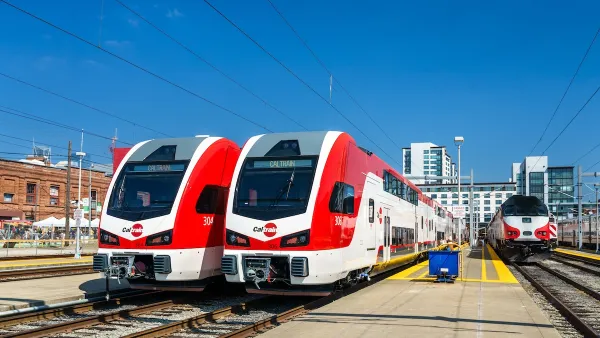
The system made the switch to faster, more modern all-electric trains in September.

Planetizen Federal Action Tracker
A weekly monitor of how Trump’s orders and actions are impacting planners and planning in America.

The state-sanctioned urbicide of Austin
People don’t kill cities. Freeways do.

US to reduce Colorado River water deliveries to Mexico
A new Colorado Treaty amendment reduces Mexico’s Colorado River water allocation by 250,000 acre feet.

5 New England states march closer to 800 megawatt wind energy project
Securing federal approval for the project may be complicated under the Trump administration, which has historically been hostile towards domestic wind power.

Baltimore to break ground on $50 million Transit Priority Project
The project will bring faster bus trips, safer streets and better bike connections to Baltimore.

Airbnb launches $250 million 'last-dollar financing' housing accelerator, makes first investment in Austin
The company will put $6.4 million towards affordable housing development in Texas’ capital.

FREE Course: Walkable City 1: Why Walkability?
After describing his path towards focusing on walkability as the essence of good planning, Jeff Speck marches through his five principal reasons for making more walkable places.
Reinventing Malls: Planning Alchemy—Turning Gray Fields Into Gold
The course focuses on the opportunities and imperatives that shape reinvention of mall sites.

Eagle County Government
Harvard University Graduate School of Design
Nashville Planning Department
The Architects Foundation
University of Cincinnati Online
The Pocatello Development Authority
The Urban Renewal Agency of the City of Pocatello
Journal of the American Planning Association