The state’s carbon trading program is being attacked as ineffective from one side and overly onerous from the other.


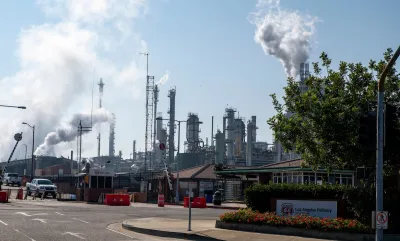
California leaders are debating the future of the state’s cap-and-trade program, which experts say is crucial to the state meeting its climate goals.
As Hayley Smith reports in the Los Angeles Times, “The cap-and-trade program was nation-leading when it was authorized by state law in 2006. It requires major polluters such as power plants, oil refineries and other industrial facilities to purchase allowances, or credits, for each ton of carbon dioxide they emit, and lets those companies buy or sell their unused allowances at quarterly auctions.” The state lowers the number of credits each year, reducing the total allowable pollution in the state.
Governor Newsom is advocating for extending the program, which expires in 2030, to 2045. But critics say the existing cap is too weak. “At the current rate of about 2.5% reductions per year, the state is not on track to meet its 2030 goal, according to an analysis from the nonprofit Next 10, which examines the state’s climate progress each year. What’s more, emissions would need to fall at about 3.5 times that rate — 8.8% per year — to reach the 2045 goal.”
The program also gives away a large number of credits for free as incentives for companies to stay in the state. “Others go to electric utilities and natural gas suppliers to keep them from passing compliance costs onto customers,” Smith adds. “As a result, opponents say, the cap-and-trade program amounts to a get-out-of-jail-free card for polluters, allowing them to continue business as usual without really eliminating harmful emissions in the state — particularly in the low-income and disadvantaged communities that tend to live closest to polluting facilities.”
The governor’s office says it hopes to finalize the program’s extension by mid-September.
FULL STORY: California’s signature climate effort is up for renewal — and it’s a fight

Meet China's New Carbon Market
The world's largest emitter of CO2, China, has adopted a cap-and-trade program would open the world's largest carbon market as early as 2016.
Encouraging Low Carbon Cities
Controlling carbon emissions hinges on encouraging cities that have small carbon footprints, writes Matthew E. Kahn.

FTA Kills ‘Social Cost of Carbon’ in Transit Grant Criteria
The Capital Investments Grant program will no longer factor in the future impacts of carbon emissions.

Planetizen Federal Action Tracker
A weekly monitor of how Trump’s orders and actions are impacting planners and planning in America.

The state-sanctioned urbicide of Austin
People don’t kill cities. Freeways do.

US to reduce Colorado River water deliveries to Mexico
A new Colorado Treaty amendment reduces Mexico’s Colorado River water allocation by 250,000 acre feet.

5 New England states march closer to 800 megawatt wind energy project
Securing federal approval for the project may be complicated under the Trump administration, which has historically been hostile towards domestic wind power.

Baltimore to break ground on $50 million Transit Priority Project
The project will bring faster bus trips, safer streets and better bike connections to Baltimore.

Airbnb launches $250 million 'last-dollar financing' housing accelerator, makes first investment in Austin
The company will put $6.4 million towards affordable housing development in Texas’ capital.

FREE Course: Walkable City 1: Why Walkability?
After describing his path towards focusing on walkability as the essence of good planning, Jeff Speck marches through his five principal reasons for making more walkable places.
Reinventing Malls: Planning Alchemy—Turning Gray Fields Into Gold
The course focuses on the opportunities and imperatives that shape reinvention of mall sites.

Eagle County Government
Harvard University Graduate School of Design
Nashville Planning Department
The Architects Foundation
University of Cincinnati Online
The Pocatello Development Authority
The Urban Renewal Agency of the City of Pocatello
Journal of the American Planning Association